


Temperature Converter: Celsius, Fahrenheit, and Kelvin Explained
Struggling to convert Celsius to Fahrenheit or Kelvin? Our comprehensive temperature guide covers everything: the history of each scale, exact conversion formulas, real-world reference points (absolute zero, room temp, body temp), and easy mental shortcuts. Perfect for students, travelers, and home cooks. Convert any temperature instantly with the free Numovix Temperature Converter.
5/31/20262 min read
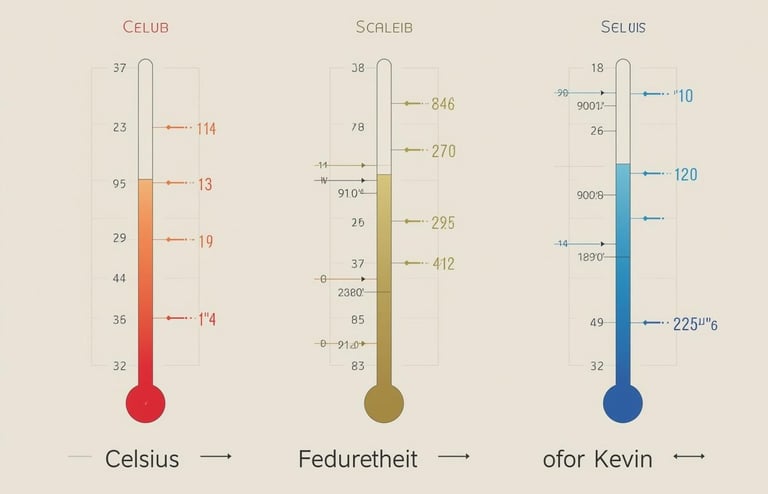
Temperature is one of the most commonly discussed measurements in everyday life — from weather forecasts to cooking recipes to scientific research. Yet temperature scales can cause significant confusion, especially when crossing between countries that use different systems. This guide explains all three major temperature scales and how to convert between them.
The Three Major Temperature Scales
Celsius (°C)
The Celsius scale is used by most of the world. It defines 0°C as the freezing point of water and 100°C as the boiling point, at standard atmospheric pressure. Developed by Swedish astronomer Anders Celsius in 1742, this scale is part of the metric system.
Fahrenheit (°F)
The Fahrenheit scale is used primarily in the United States. It defines water's freezing point at 32°F and boiling point at 212°F. This gives it a larger degree step between common human experience temperatures, which some find more intuitive for daily weather discussions. Daniel Gabriel Fahrenheit developed it in the early 1700s.
Kelvin (K)
The Kelvin scale is the scientific standard. Its zero point — absolute zero — is the coldest theoretically possible temperature, at which all molecular motion stops. 0 K = -273.15°C. Kelvin degrees are the same size as Celsius degrees; it is just shifted by 273.15. Kelvin is used in physics, chemistry, astronomy, and engineering.
Temperature Conversion Formulas
⦁ Celsius to Fahrenheit: °F = (°C × 9/5) + 32
⦁ Fahrenheit to Celsius: °C = (°F − 32) × 5/9
⦁ Celsius to Kelvin: K = °C + 273.15
⦁ Kelvin to Celsius: °C = K − 273.15
⦁ Fahrenheit to Kelvin: K = (°F − 32) × 5/9 + 273.15
Key Reference Points
⦁ Absolute zero: 0 K = -273.15°C = -459.67°F
⦁ Water freezes: 0°C = 32°F = 273.15 K
⦁ Room temperature: ~22°C = ~72°F = 295.15 K
⦁ Human body: 37°C = 98.6°F = 310.15 K
⦁ Water boils: 100°C = 212°F = 373.15 K
Quick Mental Conversion Tricks
For a rough Celsius to Fahrenheit estimate: double the Celsius temperature and add 30.
Example: 25°C → 25 × 2 = 50, + 30 = 80°F (actual: 77°F — close enough for everyday use)
For Fahrenheit to Celsius: subtract 30 and halve the result.
Conclusion
Temperature conversion is straightforward once you know the right formulas. Whether you are adjusting a recipe from a European cookbook, reading a weather app in a different country, or working on a science assignment, the Numovix Temperature Converter gives you instant, accurate results for any scale combination
Temperature Converter: Celsius, Fahrenheit, and Kelvin Explained
© 2026 Numovix. All rights reserved.
Calculators Categories
Digital & Tech
Converters Categories