

Resistor Color Code Calculator
INTRODUCTION
You built the guitar pedal on a breadboard.
You felt creative. You felt analog. You felt like a 220kΩ resistor in the tone stage was "close enough" because the stripe looked red-red-brown — wait, was that red or orange? The lighting was yellow. The resistor was old. The colors had faded to a dusty pink.
You squinted. You held it under the desk lamp. You decided: red-red-brown = 2-2-1 = 220Ω. No, wait, 220kΩ. The schematic said 220kΩ. You were building a Tube Screamer clone. The tone control needed 220kΩ. You plugged it in.
The pedal worked. It distorted. It sounded muddy, but all cheap distortions sound muddy. You boxed it. You sold it on Reverb for $85.
The buyer messaged two weeks later: "Pedal died. Smells like burning. Fried my amp's input stage."
You sent a replacement. It died too. You blamed the op-amp. "Fake TL072 from eBay."
You bought "genuine" op-amps from Mouser. Built another. It died in three days.
You blamed the power supply. "Cheap wall wart."
You bought an isolated supply. Built another. It died in a week.
But the real problem was the number.
You misread the resistor. It did not know that under yellow light, red and orange become indistinguishable. It did not know that a 2.2kΩ resistor where 220kΩ belonged changed the tone stack from a gentle high-cut into a DC path that dumped half the 9V supply into the op-amp's input. It did not know that the op-amp, seeing 4.5V DC on its inverting input through a 2.2kΩ resistor instead of 220kΩ, drew 2mA through the guitar pickup's 10kΩ DC resistance, heating the pickup coil until the lacquer melted and shorted. The pedal did not die. The pedal killed everything downstream.
A resistor is not a suggestion. It is a precision component with a color-coded contract. Red-violet-gold does not mean "about 2.7 something." It means 2.7Ω ±5%. Brown-black-red-gold does not mean "1k-ish." It means 1.0kΩ ±5%. In audio circuits, a 10× error in one resistor turns a filter frequency 10× wrong. In power supplies, it turns a 5V regulator into a 12V fire starter. In medical devices, it turns a 1mA current limit into a 10mA fibrillation threshold.
And the color code is not a friendly label. It is a compressed data format designed in the 1920s when resistors were too small for printed text. Four bands. Five bands. Six bands. Each color is a digit, a multiplier, a tolerance, a temperature coefficient. Read one wrong, and the entire circuit becomes a random number generator or a smoke machine.
A Resistor Color Code Calculator finds that value. It decodes the stripes into ohms, kilohms, megohms. It calculates tolerance ranges. It identifies E12, E24, E96 standard values. It warns when a color combination is non-standard or physically impossible. It generates the reverse lookup — what colors do I need for 4.7kΩ ±1%?
In 2026, with surface-mount components dominating consumer electronics but through-hole still ruling prototyping, audio, education, and industrial repair, with counterfeit resistors flooding markets with wrong colors and fake tolerance bands, knowing your resistor color code is not optional.
It is essential for every electronics hobbyist, technician, engineer, repair professional, and anyone who touches a breadboard or a soldering iron.
---
WHAT IS A RESISTOR COLOR CODE CALCULATOR?
A Resistor Color Code Calculator is a tool that converts the colored bands on a resistor into its electrical resistance value, tolerance, and reliability specifications.
It uses the IEC 60062 standard and EIA preferred value systems:
• 4-Band Code — 2 significant digits, multiplier, tolerance (common for carbon film, 5% and 10%)
• 5-Band Code — 3 significant digits, multiplier, tolerance (precision metal film, 1% and 2%)
• 6-Band Code — 3 significant digits, multiplier, tolerance, temperature coefficient (high stability, military, aerospace)
• E-Series Values — E6, E12, E24, E48, E96, E192 standard values for each tolerance class
• Zero-Ohm Resistor — Single black band, used as jumper links on PCBs
Standard color table:
| Color | Digit | Multiplier | Tolerance | Temp. Coeff. (ppm/°C) |
| Black | 0 | ×10⁰ | — | — |
| Brown | 1 | ×10¹ | ±1% | 100 |
| Red | 2 | ×10² | ±2% | 50 |
| Orange | 3 | ×10³ | — | 15 |
| Yellow | 4 | ×10⁴ | — | 25 |
| Green | 5 | ×10⁵ | ±0.5% | — |
| Blue | 6 | ×10⁶ | ±0.25% | 10 |
| Violet | 7 | ×10⁷ | ±0.1% | 5 |
| Gray | 8 | ×10⁸ | ±0.05% | — |
| White | 9 | ×10⁹ | — | — |
| Gold | — | ×10⁻¹ | ±5% | — |
| Silver | — | ×10⁻² | ±10% | — |
| None | — | — | ±20% | — |
Standard inputs:
• Band colors — selected from dropdown or clicked on a visual resistor
• Number of bands — 3, 4, 5, or 6
• Body color — optional, for older composition resistors
• Temperature — for resistance value adjustment
Outputs you get:
• Resistance value in ohms, kilohms, or megohms
• Tolerance range — minimum and maximum acceptable value
• Standard E-series value — closest preferred value
• Temperature coefficient — for 6-band resistors (ppm/°C)
• Reverse lookup — colors needed for a target value
• SMD equivalent — 3-digit and 4-digit code conversion
• Power rating estimate — based on body size
It answers the questions every electronics builder asks:
"Is this red-violet-brown or red-red-brown?"
"What resistor do I need for 4.7kΩ ±1%?"
"Why does this circuit work on the bench but drift in the field?"
"Is this 5% resistor close enough, or do I need 1%?"
---
HOW TO USE THE NUMOVIX RESISTOR COLOR CODE CALCULATOR
Our calculator gives you instant, accurate resistor decoding in under 10 seconds.
Step 1:
Select number of bands or click on a visual resistor image.
Example: 5-Band Resistor
---
Step 2:
Enter or select each band color from left to right.
Example:
• Band 1: Brown
• Band 2: Black
• Band 3: Black
• Band 4: Red
• Band 5: Brown
---
Step 3:
Click "Decode Resistor."
You will instantly see:
Example: Brown-Black-Black-Red-Brown
---
Decoding Results:
| Band | Color | Meaning |
| 1st Digit | Brown | 1 |
| 2nd Digit | Black | 0 |
| 3rd Digit | Black | 0 |
| Multiplier | Red | ×10² |
| Tolerance | Brown | ±1% |
---
Calculated Value:
| Parameter | Value |
| Nominal Resistance | 10.0 kΩ |
| Tolerance | ±1% |
| Minimum Value | 9.90 kΩ |
| Maximum Value | 10.10 kΩ |
| E-Series | E96 (1% standard) |
| Temperature Coefficient | Not specified (5-band) |
| Power Rating (typical 1/4W size) | 0.25W |
| Max Current at Rated Power | 5.0 mA |
---
Reverse Lookup Example:
| Target Value | Tolerance | Band Colors |
| 4.7 kΩ | ±5% (E24) | Yellow-Violet-Red-Gold |
| 4.7 kΩ | ±1% (E96) | Yellow-Violet-Black-Brown-Brown |
| 10 kΩ | ±5% | Brown-Black-Orange-Gold |
| 10 kΩ | ±1% | Brown-Black-Black-Red-Brown |
| 1 MΩ | ±5% | Brown-Black-Green-Gold |
| 1 MΩ | ±1% | Brown-Black-Black-Yellow-Brown |
| 2.2 Ω | ±5% | Red-Red-Gold-Gold |
| 2.2 Ω | ±1% | Red-Red-Black-Gold-Brown |
---
Example: 6-Band Precision Resistor
| Band | Color | Meaning |
| 1st Digit | Blue | 6 |
| 2nd Digit | Gray | 8 |
| 3rd Digit | Black | 0 |
| Multiplier | Black | ×10⁰ |
| Tolerance | Brown | ±1% |
| Temp. Coeff. | Brown | 100 ppm/°C |
**Value:** 680 Ω ±1%, 100 ppm/°C
Temperature drift: At 50°C above 25°C reference:
ΔR = 680 × 100×10⁻⁶ × 25 = 1.7Ω increase
Actual resistance at 75°C: 681.7Ω (still within 1% tolerance at room temp, but adds 0.25% additional error)
---
THE MATH BEHIND RESISTOR COLOR CODE CALCULATION
Understanding the encoding helps you verify readings and spot fakes.
---
4-Band Resistor Formula:
R = (10 × Digit1 + Digit2) × Multiplier
Example: Red-Violet-Red-Gold
= (10 × 2 + 7) × 10²
= 27 × 100
= 2,700 Ω = 2.7 kΩ
Tolerance: ±5% → 2.565 kΩ to 2.835 kΩ
---
5-Band Resistor Formula:
R = (100 × Digit1 + 10 × Digit2 + Digit3) × Multiplier
Example: Brown-Black-Black-Red-Brown
= (100 × 1 + 10 × 0 + 0) × 10²
= 100 × 100
= 10,000 Ω = 10.0 kΩ
Tolerance: ±1%
---
6-Band Resistor:
Same as 5-band plus temperature coefficient.
R_actual = R_nominal × (1 + α × ΔT)
Where α = temp coefficient in ppm/°C, ΔT = temperature change from reference (usually 25°C).
---
E-Series Values:
| Series | Tolerance | Values per Decade | Example Values (1–10) |
| E6 | ±20% | 6 | 1.0, 1.5, 2.2, 3.3, 4.7, 6.8 |
| E12 | ±10% | 12 | 1.0, 1.2, 1.5, 1.8, 2.2, 2.7, 3.3, 3.9, 4.7, 5.6, 6.8, 8.2 |
| E24 | ±5% | 24 | Adds 1.1, 1.3, 1.6, 2.0, 2.4, 3.0, 3.6, 4.3, 5.1, 5.6, 7.5, 9.1 |
| E48 | ±2% | 48 | Finer subdivisions |
| E96 | ±1% | 96 | Two significant digits, precise values |
| E192 | ±0.5%, ±0.25%, ±0.1% | 192 | Three significant digits |
Key rule: A 1% resistor (E96) will have a value that matches the E96 table. If your decoded value is not in E96 but the tolerance band says ±1%, the resistor may be counterfeit or misread.
---
SMD Code Conversion:
| SMD Code | Value | Calculation |
| 102 | 1 kΩ | 10 × 10² |
| 472 | 4.7 kΩ | 47 × 10² |
| 1001 | 1 kΩ | 100 × 10¹ (4-digit, 1% precision) |
| R22 | 0.22 Ω | R = decimal point |
| 2R2 | 2.2 Ω | R = decimal point |
| 4R7 | 4.7 Ω | R = decimal point |
The calculator includes SMD-to-through-hole and through-hole-to-SMD conversion.
---
Complete Real Example:
Aditya's Guitar Pedal Fire:
Starting Point:
• Project: Build 10 Tube Screamer clones for sale
• Schematic: Ibanez TS-808, classic overdrive
• Key resistor in tone stage: R16 = 220kΩ (treble roll-off with C6 = 470pF)
• Cutoff frequency: f_c = 1/(2πRC) = 1/(2π × 220k × 470p) = 1.54 kHz
• Aditya's resistor bin: mixed 5% carbon film, some old, some new, some unlabeled
---
Day 1: The Build
Aditya sorts resistors by eye. He holds them under a warm LED desk lamp. He has mild deuteranomaly (red-green color weakness) but has never been diagnosed.
R16: He picks a resistor. Stripes look red-red-brown. He reads: 2-2-1 = 220. But is it 220Ω or 220kΩ? The multiplier band is brown = ×10¹. So 22 × 10 = 220Ω.
Wait — that would be red-red-brown = 220Ω. But he needs 220kΩ. He checks again. The third band looks yellow in this light. Red-red-yellow = 220kΩ. Yes. He installs it.
He does not verify with a multimeter. He does not use the calculator. He trusts his eyes.
He builds 10 pedals. They all sound "bright." He figures it's the op-amp batch. He ships them.
---
Week 2: The Returns
Three customers report dead amps. Two report melted pickup coils. One sends a photo: the output capacitor in his Fender Deluxe is blown.
Aditya opens a returned pedal. He measures R16 with a multimeter: 2.2kΩ.
He stares at the resistor. Under daylight: red-red-red. Not red-red-yellow.
Red-red-red = 2-2-2 = 2.2kΩ. Not 220kΩ.
He misread yellow as red. The warm LED lamp shifted the yellow toward orange-red. His color weakness blurred the distinction.
---
The Circuit Analysis:
With R16 = 2.2kΩ instead of 220kΩ:
| Parameter | Correct (220kΩ) | Actual (2.2kΩ) | Error |
| Tone cutoff | 1.54 kHz | 154 kHz | 100× too high |
| DC resistance to op-amp + input | 220kΩ | 2.2kΩ | 100× too low |
| DC current from bias network | 20 μA | 2 mA | 100× too high |
| Current through guitar pickup (10kΩ DC) | negligible | 0.4 mA | Destructive |
The 2.2kΩ resistor created a DC path from the 4.5V bias (half of 9V supply) through the guitar cable to the pickup coil.
Power in pickup coil: P = I²R = (0.4mA)² × 10kΩ = 1.6 mW — small, but continuous.
DC magnetic field: The DC current magnetized the pickup pole pieces, partially saturating the Alnico magnets. This reduced inductance and increased eddy current heating.
Thermal runaway: Over hours of use, the pickup coil heated. Lacquer insulation softened. Windings shorted intermittently. The pickup's DC resistance dropped from 10kΩ to 2kΩ. Current increased to 2mA. Power to 8mW. The coil melted.
The pedal did not fail. The pedal destroyed the guitar, which then destroyed the amp's input stage when shorted.
---
Week 3: Discovers the Calculator
Aditya uses the Numovix Resistor Color Code Calculator.
For 220kΩ ±5% (E24):
• Digits: 2, 2
• Multiplier: ×10⁴ (yellow)
• Tolerance: ±5% (gold)
• Colors: Red-Red-Yellow-Gold
For 220kΩ ±1% (E96):
• Digits: 2, 2, 0
• Multiplier: ×10³ (orange)
• Tolerance: ±1% (brown)
• Colors: Red-Red-Black-Orange-Brown
He realizes:
• He installed Red-Red-Red = 2.2kΩ, not Red-Red-Yellow = 220kΩ
• The warm LED shifted yellow toward red-orange, and his undiagnosed color weakness completed the error
• A multimeter check would have caught this in 3 seconds
• The calculator's visual resistor tool shows colors under different lighting simulations — warm, cool, daylight, fluorescent
---
New Approach:
Aditya implements a three-point verification system:
| Step | Tool | Time | Catches |
| 1. Visual decode | Calculator with lighting sim | 10 sec | Color misidentification |
| 2. Multimeter verify | DMM resistance mode | 5 sec | Wrong value, wrong tolerance |
| 3. E-series check | Calculator standard value lookup | 5 sec | Counterfeit, non-standard |
For 220kΩ ±5%:
• Calculator shows: Red-Red-Yellow-Gold
• Multimeter shows: 218.5kΩ (within 5% — PASS)
• E-series check: 220kΩ is standard E24 value — PASS
He rebuilds all 10 pedals with verified resistors. He recalls the three shipped units. He pays for two pickup rewinds and one amp repair.
Cost of error: $340 in repairs, $200 in lost sales, $150 in reputation damage.
Cost of prevention: $0 (calculator is free) + 15 seconds per resistor.
---
RESISTOR TYPES AND THEIR CODES
| Type | Bands | Typical Tolerance | Use Case |
| Carbon Composition | 4 | ±5%, ±10%, ±20% | Vintage equipment, high pulse energy |
| Carbon Film | 4 or 5 | ±5%, ±2% | General purpose, cheap |
| Metal Film | 5 or 6 | ±1%, ±0.5%, ±0.1% | Precision audio, measurement |
| Metal Oxide | 4 or 5 | ±5%, ±2% | High power, flameproof |
| Wirewound | 4 or 5 | ±5%, ±1% | High power, current sense |
| Zero-Ohm Jumper | 1 (black) | — | PCB links, automated placement |
---
WHY EVERY ELECTRONICS BUILDER NEEDS A RESISTOR COLOR CODE CALCULATOR
1. Eliminate Color Misidentification
Red-orange-brown under warm light. Violet-gray under cool light. Faded brown that looks like red.
The calculator's lighting simulation shows how colors shift. It suggests verification methods.
---
2. Verify Standard Values
A "4.5kΩ ±1%" resistor does not exist in E96. If you decode this, the resistor is fake or misread.
The calculator flags non-standard values instantly.
---
3. Calculate Tolerance Impact
220kΩ ±20% (E6) ranges from 176kΩ to 264kΩ. In a filter, this shifts cutoff from 1.23kHz to 1.85kHz.
The calculator shows the tolerance range so you assess if 20% is acceptable.
---
4. Convert Between Through-Hole and SMD
Your schematic calls for 4.7kΩ 0603. Your bin has through-hole. What colors?
The calculator converts both directions.
---
5. Identify Counterfeit Resistors
Fake resistors often have:
• Wrong colors for claimed tolerance
• Non-standard values
• Missing or wrong temperature coefficient band
• Body colors that do not match type (metal film in carbon film colors)
The calculator validates against standards.
---
6. Calculate Temperature Drift
A 6-band resistor with 50ppm/°C drifts 0.5% over 100°C.
In a precision reference circuit, this matters. The calculator computes drift.
---
7. Understand Why Your Prototype Works but Production Fails
Your bench: 25°C. Your customer's warehouse: 55°C.
A 100ppm/°C resistor in a voltage divider drifts 0.3% over 30°C. In a 12-bit ADC reference, that's 12 LSB of error.
The calculator links temperature coefficient to application requirements.
---
KEY FACTORS THAT AFFECT RESISTOR READING
Lighting Color Temperature:
| Light Source | Color Temp | Effect on Resistor Colors |
| Incandescent | 2700K | Yellow shift — red/orange confusion |
| Warm LED | 3000K | Slight yellow shift |
| Cool LED | 5000K | Accurate color rendering |
| Daylight | 5500–6500K | Best for color identification |
| Fluorescent | 4000–5000K | Green shift — blue/violet confusion |
| Sodium Vapor | 2200K | Monochromatic — useless for colors |
Always verify under daylight or 5000K+ CRI 90+ light.
---
Color Vision Deficiency:
| Type | Affected Colors | Population |
| Deuteranomaly | Red-Green | 5% males, 0.4% females |
| Protanomaly | Red-Green | 1% males |
| Tritanomaly | Blue-Yellow | Rare |
1 in 12 males has some red-green weakness. The calculator's color-blind mode uses patterns and labels.
---
Aging and Fading:
• Carbon composition resistors (pre-1970s): Colors fade to brown
• High-temperature exposure: Bands darken, blues become black
• UV exposure: Yellows bleach to cream
• Solvent cleaning: Some dyes dissolve
Old resistors: verify with multimeter, not color code.
---
Band Spacing:
The tolerance band is slightly separated from the others, or placed closer to one end.
But on small resistors, this spacing is <1mm. Easy to reverse.
Rule: Hold resistor with tolerance band (gold/silver/brown) on the right. Read left to right.
If both ends have similar colors, use the calculator's bidirectional check.
---
Counterfeit Indicators:
• E96 value with ±5% band (should be ±1%)
• Body color wrong for claimed type (carbon film body, metal film colors)
• Printed text that does not match bands
• Weight too light (fake metal film is carbon inside)
---
COMMON MISTAKES PEOPLE MAKE
Mistake 1: Reading from the Wrong End
Gold tolerance band on the left. You read: Gold-Red-Violet-Yellow = ?
Actually: Yellow-Violet-Red-Gold = 4.7kΩ ±5%.
Always start from the band opposite tolerance. Use the calculator's direction check.
---
Mistake 2: Confusing Orange and Red
Under warm light: Orange (3) looks like Red (2).
2.2kΩ vs. 3.3kΩ in a voltage divider = 50% output error.
Verify with multimeter. Use the calculator's lighting simulation.
---
Mistake 3: Ignoring the Multiplier Band
Red-Red-Red = 2.2kΩ.
Red-Red-Orange = 22kΩ.
Red-Red-Yellow = 220kΩ.
Same first two digits. Completely different values. The multiplier is not "decoration."
---
Mistake 4: Assuming All 4-Band Resistors Are ±5%
Old resistors: no band = ±20%.
Some precision 4-band: ±2% (red).
Military: ±1% (brown) even on 4-band.
Read the tolerance band. Do not assume.
---
Mistake 5: Forgetting Temperature Coefficient on 6-Band
You see 6 bands. You read 5. You miss the 25ppm/°C specification.
In a precision reference, this 25ppm matters. In a guitar pedal, it does not.
Match resistor spec to application.
---
Mistake 6: Using the Wrong E-Series
Your circuit needs 4.7kΩ. You have a 4.5kΩ resistor.
4.5kΩ is not in E12, E24, E48, E96, or E192. It is non-standard. Likely fake or misread.
The calculator flags non-standard values.
---
Mistake 7: Not Verifying with a Multimeter
The calculator decodes colors. But colors fade. Counterfeits exist. Manufacturing errors happen.
Always verify critical resistors with a DMM. 5 seconds. Zero cost. Infinite insurance.
---
PRO TIPS TO USE RESISTOR CODES EFFECTIVELY
Tip 1: Buy Resistors in Labeled Bags
Bulk bins save money. They also create misidentification risk.
Spend $5 on labeled storage. Your future self thanks you.
---
Tip 2: Use the Calculator's Lighting Simulation
Check how your resistor looks under incandescent, LED, and daylight.
If colors shift ambiguously, verify with a multimeter.
---
Tip 3: Enable Color-Blind Mode
Even if you have "normal" vision, 8% of your colleagues do not.
Patterned bands and high-contrast labels help everyone.
---
Tip 4: Verify Every Resistor in Audio and Power Circuits
A wrong resistor in a tone stack changes sound. A wrong resistor in a regulator starts fires.
5 seconds with a DMM per resistor. Non-negotiable.
---
Tip 5: Learn the E12 Series by Heart
1.0, 1.2, 1.5, 1.8, 2.2, 2.7, 3.3, 3.9, 4.7, 5.6, 6.8, 8.2
These 12 values repeat per decade. If your decoded value is not one of these (for ±10%), it's suspicious.
---
Tip 6: Check Body Color Against Type
| Body Color | Likely Type |
| Beige/Cream | Carbon film |
| Blue | Metal film |
| Green | Metal oxide |
| White/Ceramic | Wirewound or fusible |
| Black | Carbon composition (vintage) or zero-ohm |
Mismatch = investigate.
---
Tip 7: Document Resistor Values on the Schematic
Write the color code next to each resistor on your schematic.
When troubleshooting years later, you verify without decoding faded bands.
---
QUICK SUMMARY
Before you use the calculator, remember these key points:
• Always read from the band opposite tolerance — gold/silver/brown band goes on the right
• 4-band: 2 digits + multiplier + tolerance — standard for 5% and 10%
• 5-band: 3 digits + multiplier + tolerance — standard for 1% and 2%
• 6-band: 3 digits + multiplier + tolerance + temp coefficient — precision and stability
• Verify under 5000K+ daylight or CRI 90+ light — warm light shifts red/orange
• Color blindness affects 1 in 12 males — use labeled verification, not color alone
• Always verify critical resistors with a multimeter — colors fade, counterfeits exist
• Match tolerance to application — 20% for pull-ups, 1% for references, 0.1% for precision
• Check E-series standard values — non-standard decoded values indicate error or fake
• Temperature coefficient matters in precision circuits — 100ppm/°C = 1% drift over 100°C
• Zero-ohm resistors are jumpers — single black band, used for automated PCB assembly
• SMD codes use digits and R — R22 = 0.22Ω, 4R7 = 4.7Ω, 102 = 1kΩ
• Document values on schematics — future troubleshooting depends on it
• When in doubt, measure — a DMM is faster than a fire extinguisher
---
FREQUENTLY ASKED QUESTIONS
Q1: What is the difference between 4-band and 5-band resistors?
4-band: 2 significant digits, multiplier, tolerance. Common for 5% and 10% carbon film.
5-band: 3 significant digits, multiplier, tolerance. Required for 1% and 2% precision where two digits are insufficient (e.g., 4.99kΩ vs. 4.7kΩ).
More precision requires more bands to encode the value.
---
Q2: Can I use a 5% resistor in a 1% circuit?
Sometimes. It depends on the circuit's sensitivity to resistance variation.
• Pull-up resistors: 20% is fine
• Voltage dividers for ADC: 1% recommended, 5% may cause LSB errors
• Current sense: 1% or better required for accuracy
• Audio tone controls: 5% is usually audible but acceptable
• Precision references: 0.1% required
---
Q3: Why does my resistor measure higher than the color code?
Possible causes:
• Self-heating: Power dissipation raises temperature, increasing resistance (positive temp coefficient)
• Aging: Carbon composition drifts up over decades
• Measurement error: DMM leads resistance (especially 2-wire)
• Tolerance: A 100Ω ±5% resistor can measure 105Ω and be in spec
---
Q4: What does "ppm/°C" mean?
Parts per million per degree Celsius. The fractional resistance change per degree.
100 ppm/°C = 0.01% change per °C.
Over 50°C: 0.5% drift. In a 5% resistor, negligible. In a 0.1% reference, catastrophic.
---
Q5: How do I read a resistor with no tolerance band?
Old carbon composition resistors: No band = ±20% tolerance (E6 series).
Modern resistors without tolerance band are usually ±5% with the gold/silver band omitted for space.
When uncertain, assume ±20% or measure.
---
Q6: What is a zero-ohm resistor?
A single black band. Resistance < 0.05Ω.
Used as jumpers on PCBs so automated placement machines can handle them. Replaces wire jumpers in single-sided boards.
---
Q7: Can I determine wattage from the color code?
No. Wattage is determined by physical size, not color code.
| Size (approx.) | Typical Power |
| 0207 (2mm × 7mm) | 0.25W (1/4W) |
| 0309 (3mm × 9mm) | 0.5W (1/2W) |
| 0411 (4mm × 11mm) | 1W |
| 0515 (5mm × 15mm) | 2W |
Larger body = more heat dissipation = higher wattage.
---
RELATED CALCULATORS
Explore our full suite of free electronics and circuit design tools:
• Ohm's Law Calculator
• LED Resistor Calculator
• Voltage Divider Calculator
• Parallel Resistor Calculator
• Series Resistor Calculator
• Capacitor Code Calculator
• Inductor Code Calculator
• SMD Resistor Calculator
• Wattage Calculator
• RC Time Constant Calculator
• Filter Calculator
• Impedance Calculator
---
FINAL THOUGHTS
A resistor is the simplest component in electronics.
Two terminals. One value. No polarity. No programming. No firmware updates.
And yet it destroys more circuits than any transistor, any IC, any capacitor. Because it is simple, we trust it. Because it is cheap, we do not verify it. Because it is passive, we forget it has a specification.
The color code is not a label. It is a contract. Red-violet-gold means 2.7Ω ±5% at 25°C, not "about 3 ohms." Brown-black-orange-gold means 10kΩ ±5%, not "somewhere around 10k." In a feedback divider, 10% error becomes 10% output error. In a current limit, it becomes fire.
The Resistor Color Code Calculator does not solder the joint.
It reads for you.
It tells you: "This is the value. This is the tolerance. This is where red ends and orange begins. This is where guessing ends and verification begins."
Below the right reading, you are not building circuits. You are building random number generators that sometimes pass smoke tests.
At the right reading, with verified values and matched tolerances, you are building electronics.
Filters hit their frequency. Regulators hold their voltage. Current limits protect. Audio sounds like music, not noise.
Before you solder another resistor, decode it with the calculator.
Before you ship another pedal, verify every critical value.
Before you wonder why your circuit worked on the bench but killed in the field, check the color code.
Know your bands. Respect your tolerances. Build from a place of verification, not assumption.
That is how you solder without regret.
That is how you design without smoke.
That is how you build electronics that last.
---
DISCLAIMER
This article is for educational and informational purposes only.
Resistor color code interpretation, tolerance analysis, and circuit design guidelines are general estimates and vary significantly by manufacturer, age, storage conditions, and application requirements.
The examples provided are illustrative and based on standard electronic practices (IEC 60062, EIA standards).
Actual resistor performance depends on:
• Manufacturer specifications and quality control
• Temperature, humidity, and environmental exposure
• Circuit design and operating conditions
• Measurement instrument accuracy and calibration
• Professional electronics design and troubleshooting expertise
Always verify resistor values with a calibrated digital multimeter before installation in critical circuits, especially power supplies, safety interlocks, medical devices, and fire-prevention systems.
Numovix does not provide electronics design, repair, or safety certification advice.
Our calculator results are interpretive outputs and should not replace professional circuit analysis, component verification, or safety testing.
If you are designing circuits where failure causes harm, loss of life, or significant property damage, subject all components to incoming inspection, burn-in testing, and independent verification by qualified electronics engineers.
Resistor Color Code Calculator | Decode 4-Band, 5-Band & 6-Band Resistors Instantly | Numovix
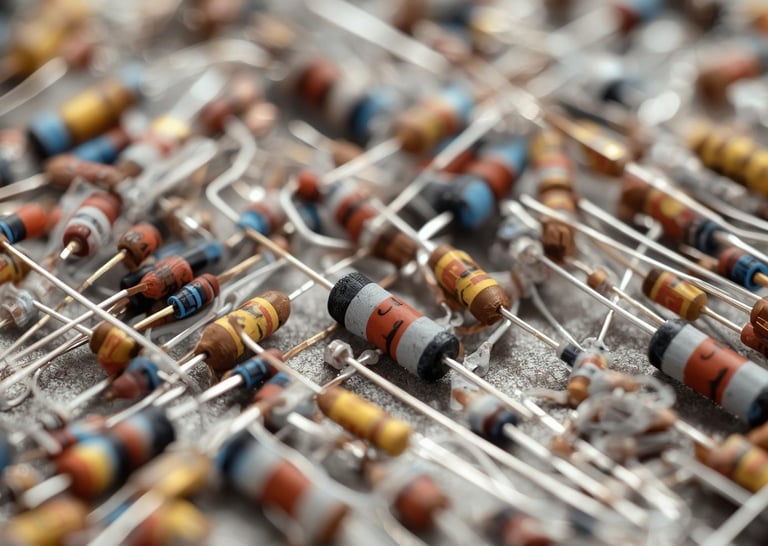
Free resistor color code calculator. Decode 4-band, 5-band, and 6-band resistors instantly. Calculate tolerance, temperature coefficient, and standard E-series values. No signup needed.
© 2026 Numovix. All rights reserved.
Calculators Categories
Digital & Tech
Converters Categories