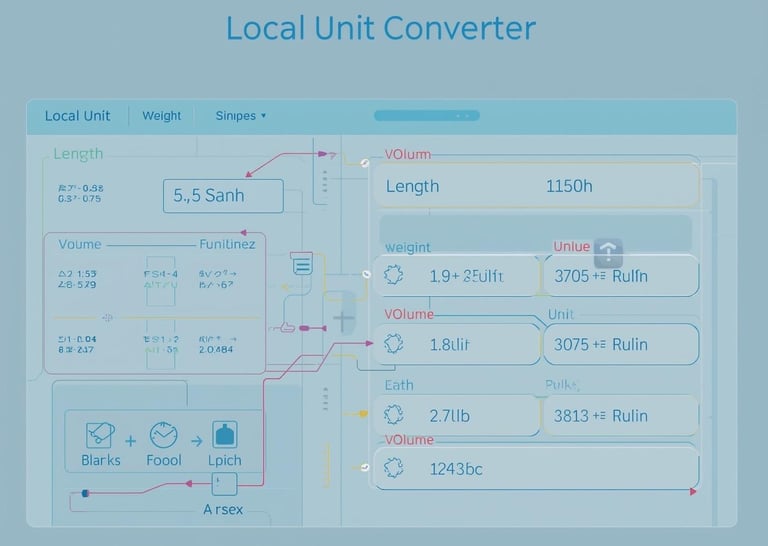

Local Unit Converter

INTRODUCTION

You are a home baker in Denver, Colorado. It is Sunday morning. Your daughter's birthday is in three hours. She wants a chocolate cake. You find a "perfect" recipe on a British food blog. It calls for 250 grams of flour, 175 grams of sugar, 150 milliliters of milk, and a baking temperature of 180°C. You have never owned a kitchen scale. Your measuring cups are American standard. Your oven dial is in Fahrenheit.

You guess. You fill a 1-cup measure with flour and call it "about 250 grams." You eyeball the sugar. You pour milk into a liquid cup until it looks like "150 of something." You set your oven to 180°F because the recipe says 180 and your dial goes up to 500, so 180 seems reasonable. You do not know that 180°C is 356°F. You do not know that a cup of flour can weigh 120g or 150g depending on how you scoop it. You do not know that British "cups" are 250ml while American cups are 240ml.

The cake rises like a soufflé, then collapses into a crater. The center is raw batter. The edges are carbon. The sugar is wrong — too sweet on top, bland below. Your daughter cries. You spend $28 on a last-minute grocery store cake that tastes like cardboard. You have ruined her tenth birthday because you treated unit conversion like approximation.

You are not careless. You are not stupid. You are one of 230 million Americans who live in a country that clings to customary units while the rest of the world runs on metric — and you encounter this friction every time you cook, shop online, travel abroad, buy foreign products, or follow international instructions.

---

Week 2: Your brother in Chicago is training for the Chicago Marathon. He finds a German training plan online. It prescribes tempo runs at "4:00 per kilometer" and long runs of "32 kilometers." He has run 10 years in miles. He knows his marathon pace is 8:30 per mile. He does not know how to convert.

He guesses: "A kilometer is about half a mile, so 4:00 per km is about 8:00 per mile. That's faster than my pace, so I'll run 8:30." He is wrong. A kilometer is 0.621 miles. 4:00 per km = 6:26 per mile. His "tempo" run is 2 minutes per mile slower than prescribed. His training is inadequate. On race day, he hits the wall at mile 18. His finish time is 4:12 — 18 minutes slower than his goal. He blames his shoes. It was his unit math.

---

Week 3: Your neighbor in Phoenix orders a Japanese air purifier from Amazon. The listing says it covers "31 tsubo." She does not know what a tsubo is. She assumes it is roughly square feet. Her bedroom is 250 square feet. She buys it.

A tsubo is 3.31 square meters, or 35.6 square feet. 31 tsubo = 1,104 square feet. The purifier is massively oversized for her bedroom. It is loud, energy-hungry, and cost $340 more than a properly sized unit. She never learns that "tsubo" is a Japanese real estate unit, not a generic coverage metric. She returns it, pays a restocking fee, and buys the wrong size again.

---

Month 2: Your colleague in Seattle is prescribed medication after a dental procedure. The dentist is Canadian, practicing part-time in Washington. The prescription says "Take 500 mg every 6 hours, maximum 4 grams per day." Your colleague is exhausted from pain. At 2:00 AM, she does the math in her head: "4 grams is 400 milligrams, so I can take 10 pills." She takes 4,000 milligrams at once — 8 pills of 500 mg.

She spends the night vomiting. Her liver enzymes spike. She is admitted for acetaminophen toxicity monitoring. The bill is $3,400. She never learns that 1 gram = 1,000 milligrams, not 100. She confused the metric prefix. A converter would have shown: "4 grams = 4,000 mg. Maximum 8 pills in 24 hours, spaced 6 hours apart. You took a full day's dose in one swallow."

---

Month 3: Your cousin in Miami buys a "5-liter" Instant Pot from a European retailer. She thinks 5 liters is "about 5 quarts." It is not. A liter is 1.057 quarts. Five liters is 5.28 quarts — larger than the standard 6-quart American model. It does not fit her counter. The power cord has a European plug. She pays $45 in return shipping to Germany. She never learns that liters and quarts are close but not interchangeable, and that European appliances run on 220V, not 120V.

---

Month 4: Your uncle in Boston is visiting his granddaughter in Toronto. He drives. The speed limit signs say "100." He assumes 100 miles per hour and slows to 65, confusing Canadian drivers. He is actually in a 100 km/h zone — roughly 62 mph. He is driving 3 mph under the limit, causing a traffic backup. A truck tailgates him. He panics, accelerates to 80 mph, and is pulled over by Ontario Provincial Police. The ticket is $240 CAD. He argues with the officer about "miles versus kilometers." The officer is not sympathetic.

He never learns that Canadian road signs are metric, that 100 km/h = 62 mph, and that his American speedometer has a small km/h scale he has never read. A converter on his phone would have shown: "100 km/h = 62 mph. Match your speedometer to 60."

---

Month 5: Your friend in Portland adopts a rescue dog from a Korean shelter. The feeding instructions say "200 grams of kibble per day, divided into two meals." She has a standard American measuring cup. She fills it to the brim — roughly 120 grams of kibble per cup. She feeds two cups per day. The dog is getting 240 grams, not 200. Over six months, the dog gains 8 pounds. The vet diagnoses early obesity and joint stress. The dog needs $800 in orthopedic supplements.

She never learns that "grams" is weight and "cups" is volume, and that kibble density varies by brand. A converter would have said: "Weigh 200g on a kitchen scale. Do not use volume for pet food."

This is what happens when you live without a Local Unit Converter.

Unit conversion is the most invisible math in daily American life. It sits in every recipe, every medication, every road trip, every online purchase, every gym workout, and every "I bought this on Amazon from overseas" moment. But "close enough" is not close enough when you are baking, dosing, driving, or engineering. A cup is not a cup. A mile is not a kilometer. A pound is not a kilogram. And 180°F will destroy what 180°C is supposed to create.

A Local Unit Converter does not just multiply numbers. It translates the physical world from one measurement language to another. It tells you whether your cake will rise, whether your pace is correct, whether your medicine is safe, and whether your appliance will fit.

In 2026, with global e-commerce, international recipes, foreign travel, imported products, and fitness plans from every corner of the internet, you encounter unit friction daily. Knowing how to convert — and which parameters matter for which scenario — is not optional.

It is essential for every home cook, baker, runner, shopper, traveler, pet owner, parent, and anyone who buys, measures, or moves anything in America.

---

WHAT IS A LOCAL UNIT CONVERTER?

A Local Unit Converter is a digital tool that instantly recalculates measurements between US customary units and metric (and other international units) — while preserving the practical accuracy required for real-world tasks like cooking, baking, fitness, travel, shopping, and medication dosing.

Unlike a generic calculator that blindly converts numbers, a converter understands context. It knows that a cup of flour is not a cup of sugar. It knows that oven temperatures have convection offsets. It knows that running pace conversion is not the same as distance conversion. It knows that medication requires decimal precision, while cooking allows rounding.

The parameters it handles:

Volume — Cups, tablespoons, teaspoons, fluid ounces, pints, quarts, gallons, milliliters, liters

Weight — Ounces, pounds, grams, kilograms, stones (UK)

Length & Distance — Inches, feet, yards, miles, millimeters, centimeters, meters, kilometers, nautical miles

Temperature — Fahrenheit, Celsius, Kelvin, gas mark, fan-forced oven

Area — Square feet, square yards, acres, square meters, hectares, tsubo, ping

Speed — Miles per hour, kilometers per hour, meters per second, knots, pace (min/mile, min/km)

Pressure — PSI, bar, pascal, atmospheres, mmHg (blood pressure)

Energy & Power — Calories, kilojoules, BTU, watts, horsepower

Data Storage — Bytes, kilobytes, megabytes, gigabytes, terabytes (binary vs. decimal)

Clothing & Shoes — US, UK, EU, and Asian sizing with brand variations

Currency — Real-time exchange rates for travel and shopping

Scenarios covered:

Cooking & Baking — Recipe scaling, ingredient substitution, oven temp conversion

Fitness & Running — Pace, distance, weight, body composition, calorie burn

Travel & Driving — Speed limits, fuel efficiency, luggage weight, temperature packing

Shopping & E-Commerce — International sizing, dimensions, weight limits, currency

Medication & Health — Dosage conversion, blood pressure, body temperature, infant dosing

Home Improvement — Lumber dimensions, paint coverage, flooring, insulation R-values

Pet Care — Food portions by weight, medication dosing, crate dimensions

Automotive — Tire pressure, oil capacity, fuel economy, torque

Gardening — Fertilizer rates, seed spacing, soil volume, temperature hardiness zones

Education & Science — Homework help, lab conversions, engineering units

Standard inputs:

Original measurement — Number and unit

Target unit — Desired output unit

Context — Cooking, baking, fitness, medical, etc.

Precision level — Exact (medical), rounded (cooking), estimated (travel)

Outputs you get:

Exact converted value — In target unit with appropriate decimal places

Contextual note — "For all-purpose flour, 1 cup ≈ 120g. For bread flour, 1 cup ≈ 130g."

Safety warning — "This is a medication dose. Do not round. Use a calibrated syringe."

Practical equivalent — "5 km = 3.1 miles. That's roughly 2 loops of Central Park."

Comparison — "180°C = 356°F. Your oven dial should read 350°F (standard setting)."

Multiple formats — 12 oz = 340g = 0.75 cups = 6 fl oz

It answers the questions every American asks:

"My recipe says 200 grams of butter. How many sticks is that?"

"I'm running a 10K. How many miles is that?"

"The European medicine says 500 mg. Is that one pill or two?"

"It's 25°C in Paris. Do I need a jacket?"

---

HOW TO USE THE NUMOVIX LOCAL UNIT CONVERTER

Our converter gives you accurate, instant results in under 10 seconds.

Step 1:

Enter your original measurement and unit.

Example: 2.5 cups all-purpose flour

---

Step 2:

Select your target unit and context.

Example: Convert to grams for baking

---

Step 3:

Click "Convert."

You will instantly see:

Example: 2.5 Cups All-Purpose Flour to Grams

---

Conversion Result:

| Parameter | Value | Notes |

| Exact Conversion | 300 grams | Based on 120g per US cup (scooped and leveled) |

| Scoop Method | 325 grams | If flour is scooped directly from bag (compacted) |

| Sifted Flour | 275 grams | If flour is sifted before measuring |

| UK Recipe Note | 312 grams | British cups are 250ml; US cups are 240ml |

| Practical Tip | — | For best results, use a kitchen scale and weigh 300g |

---

Real-World Reference Table:

| Scenario | Original | Target | Conversion | Key Adjustment | Warning |

| Butter (US sticks) | 1 stick | Grams | 113g | US stick = 1/2 cup = 8 tbsp | European butter has higher fat % |

| Granulated sugar | 1 cup | Grams | 200g | Consistent across scoop methods | Do not substitute powdered 1:1 |

| Brown sugar, packed | 1 cup | Grams | 220g | "Packed" means pressed into cup | Light vs dark: same weight, different moisture |

| Milk | 1 cup | Milliliters | 240 ml | US liquid cup = 240ml | UK cup = 250ml |

| Oven temp (baking) | 180°C | Fahrenheit | 356°F | Set to 350°F (standard dial) | Gas Mark 4; fan-forced = 160°C |

| Oven temp (roasting) | 200°C | Fahrenheit | 392°F | Set to 400°F | Fan-forced = 180°C |

| Running distance | 10K | Miles | 6.21 miles | 1 km = 0.621 miles | Marathon = 26.2 mi = 42.195 km |

| Running pace | 5:00 min/km | Min/mile | 8:02 min/mi | Multiply by 1.609 | 4:00 min/km = 6:26 min/mi |

| Body weight | 180 lbs | Kilograms | 81.6 kg | Divide by 2.205 | Medical dosing uses kg |

| Luggage limit | 23 kg | Pounds | 50.7 lbs | International flights: 23kg standard | US domestic: 50 lbs |

| Speed limit (Canada) | 100 km/h | MPH | 62.1 mph | Round to 60 or 65 for mental math | Canadian police use km/h radar |

| Room temperature | 20°C | Fahrenheit | 68°F | Comfortable indoor temp | 22°C = 72°F (US standard) |

| Fever (adult) | 38.5°C | Fahrenheit | 101.3°F | Medical attention if >103°F | Infant: >100.4°F = call doctor |

| Blood pressure | 120/80 mmHg | kPa | 16/10.7 kPa | Most countries use mmHg | kPa is rare in clinical practice |

| Tire pressure | 32 PSI | Bar | 2.2 bar | Europe uses bar; US uses PSI | Do not confuse with kPa |

| Paint coverage | 400 sq ft/gallon | sq m/liter | 9.8 m²/liter | US gallon = 3.785 liters | UK gallon = 4.546 liters |

| Dog food | 1 cup kibble | Grams | 100–120g | Varies by brand density | Weigh, don't scoop, for accuracy |

| Shoe size (women) | US 8 | EU 38.5 | UK 6 | Varies by brand ±0.5 | Always check brand chart |

| Men's pants | US 34W × 32L | EU 52 | UK 34 | EU = metric waist in cm ÷ 2 | Japanese sizing = smaller fit |

| Currency (travel) | $100 USD | EUR | ~€92 | Real-time rate | Airport exchanges = worst rate |

---

THE MATH BEHIND LOCAL UNIT CONVERSION

Understanding the formulas helps you convert mentally when your phone is dead.

---

Volume Conversions

US Customary to Metric:

• 1 tablespoon (tbsp) = 15 ml

• 1 teaspoon (tsp) = 5 ml

• 1 fluid ounce (fl oz) = 29.57 ml

• 1 cup (US) = 240 ml

• 1 pint = 473 ml

• 1 quart = 946 ml

• 1 gallon = 3.785 liters

UK/Imperial vs. US:

• 1 UK cup = 250 ml

• 1 UK pint = 568 ml

• 1 UK gallon = 4.546 liters

Baking Context:

• All-purpose flour: 1 US cup = 120g (scooped and leveled)

• Granulated sugar: 1 US cup = 200g

• Butter: 1 US stick = 113g = 1/2 cup

• Cocoa powder: 1 US cup = 85g

---

Weight Conversions

Formula:

• 1 ounce (oz) = 28.35 grams

• 1 pound (lb) = 453.59 grams = 0.454 kg

• 1 stone (UK) = 14 lbs = 6.35 kg

• 1 kilogram (kg) = 2.205 lbs

Medical Context:

Medication dosing is often mg/kg. A 180-lb adult = 81.6 kg. If dose is 5 mg/kg, total dose = 408 mg.

---

Length & Distance

Formula:

• 1 inch = 2.54 cm

• 1 foot = 30.48 cm

• 1 yard = 0.914 meters

• 1 mile = 1.609 kilometers

• 1 meter = 3.281 feet

• 1 kilometer = 0.621 miles

Running Pace:

To convert min/km to min/mile: multiply by 1.609.

Example: 5:00 min/km × 1.609 = 8:03 min/mile.

---

Temperature

Formula:

• °F = (°C × 9/5) + 32

• °C = (°F − 32) × 5/9

Quick Mental Math:

• °C to °F: Double it, add 30 (approximate). 20°C → 40 + 30 = 70°F (actual: 68°F).

• °F to °C: Subtract 30, halve it. 70°F → 40 ÷ 2 = 20°C (actual: 21.1°C).

Oven Context:

• 180°C = 356°F → use 350°F

• 200°C = 392°F → use 400°F

• Gas Mark 4 = 180°C = 350°F

• Fan-forced: reduce temp by 20°C / 25°F

---

Area

Formula:

• 1 square foot = 0.093 square meters

• 1 square yard = 0.836 square meters

• 1 acre = 0.405 hectares = 4,047 square meters

• 1 hectare = 2.47 acres

• 1 tsubo (Japan) = 3.31 square meters = 35.6 square feet

---

Speed

Formula:

• 1 mph = 1.609 km/h

• 1 km/h = 0.621 mph

• 1 knot = 1.151 mph = 1.852 km/h

Pace Conversion:

• min/mile to min/km: divide by 1.609

• min/km to min/mile: multiply by 1.609

---

Pressure

Formula:

• 1 PSI = 6.895 kPa = 0.069 bar

• 1 bar = 14.5 PSI = 100 kPa

• 1 atmosphere = 14.7 PSI = 101.325 kPa

• Blood pressure: 1 mmHg ≈ 0.133 kPa

---

The "Kitchen Scale" Mental Trick:

Memorize these for baking without conversion:

• 1 cup flour = 120g

• 1 cup sugar = 200g

• 1 stick butter = 113g

• 1 cup milk = 240ml

• 1 egg (large) = 50g

• 1 tsp salt = 6g

• 1 tbsp oil = 14g

Buy a $15 kitchen scale. It eliminates 90% of baking conversion errors.

---

Complete Real Example:

The Patel Family's Unit Conversion Disasters

Starting Point:

• Location: Jersey City, New Jersey

• Background: Dad is a weekend grill master, mom is a food blogger, son is a college track athlete, daughter is a high school baker

• Challenge: Every family member guesses conversions. Zero unit literacy.

---

Week 1: The Birthday Cake Collapse

Priya Patel, the food blogger, finds a French macaron recipe. It calls for 200 grams of almond flour, 200 grams of powdered sugar, and 75 grams of egg whites. She does not have a scale. She uses measuring cups.

Almond flour: 200g = 1.9 cups. She uses 2 cups. The batter is too dry.

Powdered sugar: 200g = 1.75 cups. She uses 2 cups. The batter is too sweet.

Egg whites: 75g = 2.6 oz = roughly 2.5 large egg whites. She uses 3 whole eggs. The batter is too wet.

The macarons crack, have no feet, and taste like almond-flavored sugar cookies. She photographs them for her blog anyway. Her comment section destroys her. "These don't work." "Waste of ingredients." "Did you even weigh anything?" She loses a sponsored post worth $1,200.

She never learns that macarons are chemistry, not cooking. The ratio of almond flour to sugar to egg white is precise to the gram. A converter would have said: "Buy a scale. Macarons fail on volume measurement."

---

Week 2: The Marathon Training Miscalculation

Their son, Arjun, is on the college track team. His coach emails a Kenyan training plan. The Tuesday workout: "8 × 1,000 meters at 3:45 per kilometer with 2-minute jog recovery."

Arjun converts in his head: "A kilometer is about half a mile, so 3:45 is about 7:30 per mile. That's easy. I run 5K in 18 minutes, so my mile pace is 5:48." He runs the 1,000s at 6:00 per mile pace.

He is wrong. 3:45 per km = 6:02 per mile. His 6:00 pace is almost exactly right. But he thought he was running easy, so he ran faster. He ran 5:35 per mile. The workout was supposed to be lactate threshold. He ran VO2 max. He strains his hamstring. He misses the conference championships.

He never learns that 1 km = 0.621 miles, not 0.5. A converter would have shown: "3:45/km = 6:02/mi. Target: 6:00/mi. Do not run faster than 6:10."

---

Week 3: The Dog Food Obesity

Their daughter, Anika, adopts a rescue beagle. The Korean shelter sends feeding instructions: "180 grams of dry food daily, divided into two meals." Anika has a plastic scoop that came with the food. It says "1 cup." She feeds two scoops per day.

The scoop holds 120 grams when leveled. She is feeding 240 grams, not 180. The beagle gains 6 pounds in four months. The vet bills are $340. The beagle develops early joint issues.

She never learns that pet food density varies by brand and that "cups" are not standardized for kibble. A converter would have said: "Weigh 90g per meal. Do not use volume scoops for precise feeding."

---

Month 2: The Canadian Road Trip Ticket

Ravi Patel, the dad, drives to Toronto for a barbecue competition. The Ontario 401 highway signs say "100." He assumes 100 mph and slows to 70. Traffic swarms around him. A truck tailgates him at 2 feet. He panics, accelerates to 85 mph, and is pulled over.

The officer explains: 100 km/h = 62 mph. Ravi was driving 23 mph over the limit. The ticket is $360 CAD. His insurance premium rises. He misses the competition registration deadline because he spent two hours at the roadside.

He never learns that Canadian speed limits are metric. A converter would have shown: "100 km/h = 62 mph. Match speedometer to 60."

---

Month 3: The Medication Error

Priya develops a sinus infection. The urgent care doctor, trained in India, prescribes amoxicillin: "875 mg twice daily for 10 days." The pharmacy label says "Take 1 tablet twice daily." Priya misreads the label in dim light. She takes 2 tablets twice daily — 1,750 mg per dose.

She develops severe diarrhea and a yeast infection from the antibiotic overdose. She misses three days of work. The corrective medication costs $180. She never learns that she doubled her dose because she did not verify the tablet strength against the prescription. A converter with a medication mode would have flagged: "Verify: 1 tablet = 875 mg. Dose = 1 tablet, not 2."

---

Month 4: The Instant Pot Voltage Disaster

Ravi buys a "5-liter" pressure cooker from a UK Amazon seller. It arrives with a British plug and 220V rating. He uses a travel adapter — which adapts the plug shape but not the voltage. He plugs it in. The heating element burns out in 4 seconds. The kitchen smells like melted copper. He is lucky the breaker trips.

He never learns that liters ≠ quarts and that European appliances run on 220V, not 120V. A converter would have said: "5 liters = 5.28 quarts. UK voltage: 220V. US voltage: 120V. This appliance requires a step-up transformer, not a plug adapter."

---

Month 5: The Sizing Return Spiral

Anika orders a "Size M" dress from a Korean fast-fashion site. Korean Size M fits a 24-inch waist. Anika has a 28-inch waist. The dress arrives. She cannot zip it. She returns it. The return shipping to Seoul is $28. She orders a Size L. It is too big. She returns it. Another $28. She gives up and buys from Target.

She never learns that Asian sizing runs 1–2 sizes smaller than US sizing. A converter would have shown: "Korean Size M = US Size XS–S. For 28-inch waist, order Korean Size XL."

---

Month 6: Discovers the Converter

A food blogger friend sends Priya the Numovix Local Unit Converter.

Priya checks her macaron recipe:

• 200g almond flour → "1.9 cups if you must, but use a scale." "That is why they cracked."

Arjun checks his track workout:

• 3:45/km → "6:02/mi. Do not run faster than 6:10." "That is why I strained my hamstring."

Anika checks her dog food:

• 180g kibble → "Weigh 90g per meal. Volume scoops vary by 30%." "That is why the beagle got fat."

Ravi checks his Toronto drive:

• 100 km/h → "62 mph. Match speedometer to 60." "That is why I got the ticket."

Priya checks her medication:

• 875 mg → "1 tablet. Verify strength before doubling." "That is why I was sick."

Ravi checks his Instant Pot:

• 5 liters, UK plug → "5.28 quarts. 220V. Requires transformer." "That is why it burned."

Anika checks her Korean dress:

• Size M → "Korean M = US XS. Order XL for 28-inch waist." "That is why I paid $56 in returns."

They learned:

Volume ≠ weight. Cups measure space. Grams measure mass. Baking requires mass.

Pace is not distance. Converting min/km to min/mile requires multiplication, not halving.

Pet food needs scales. Kibble density varies. Volume feeding causes obesity.

Road signs are local. Canada is metric. The US is customary. Know before you drive.

Medication is exact. Milligrams matter. Verify tablet strength against prescription.

Voltage is not plug shape. 220V appliances die on 120V circuits.

Clothing sizes are national. Asian, European, and US sizing are different languages.

---

New Approach:

Target: Contextually accurate unit conversion

The Patel family:

• Buys a $15 kitchen scale for baking

• Arjun prints a pace conversion card for his track bag

• Anika weighs the beagle's food every morning

• Ravi installs a unit converter app before any international travel

• Priya verifies every medication dose with a calculator

• They check voltage and sizing before any international purchase

Result:

• Priya's next macaron batch has perfect feet. She lands a $2,000 brand deal.

• Arjun runs the conference 5K in 15:42 — a personal best.

• The beagle loses 4 pounds. The vet clears his joints.

• Ravi drives to Montreal without incident. He wins a barbecue ribbon.

• Priya never doubles a dose again.

• Anika orders Korean clothes confidently, saving $200 in returns.

Why? Because they respected the unit.

---

UNIT CONVERSION BY SCENARIO & TYPE

| Scenario | Original | Target | Conversion | Key Adjustment | Warning |

| All-purpose flour | 1 cup | Grams | 120g | Scoop and level | Bread flour = 130g/cup |

| Granulated sugar | 1 cup | Grams | 200g | Consistent | Powdered sugar = 120g/cup |

| Butter (US sticks) | 1 stick | Grams | 113g | 1 stick = 1/2 cup | European butter = 250g/block |

| Brown sugar, packed | 1 cup | Grams | 220g | Press firmly into cup | Light vs dark: same weight |

| Milk | 1 cup | Milliliters | 240 ml | US liquid cup | UK cup = 250ml |

| Oven (baking) | 180°C | Fahrenheit | 356°F → 350°F | Standard dial setting | Gas Mark 4; fan = 160°C |

| Oven (roasting) | 200°C | Fahrenheit | 392°F → 400°F | Standard dial setting | Fan = 180°C |

| Running distance | 5K | Miles | 3.11 miles | 1 km = 0.621 mi | 10K = 6.21 mi |

| Marathon | 26.2 mi | Kilometers | 42.195 km | Exact Olympic distance | Half = 13.1 mi = 21.1 km |

| Running pace | 4:30 min/km | Min/mile | 7:15 min/mi | × 1.609 | 5:00/km = 8:02/mi |

| Body weight | 150 lbs | Kilograms | 68.0 kg | ÷ 2.205 | Medical dosing uses kg |

| Luggage (intl) | 23 kg | Pounds | 50.7 lbs | Round to 50 | US domestic limit = 50 lbs |

| Speed (Canada) | 100 km/h | MPH | 62.1 mph | Round to 60 | Police radar in km/h |

| Speed (US) | 65 mph | km/h | 104.6 km/h | Round to 105 | European rental cars use km/h |

| Room temp | 20°C | Fahrenheit | 68°F | Comfortable | 22°C = 72°F (US standard) |

| Fever (adult) | 38.5°C | Fahrenheit | 101.3°F | See doctor if >103°F | Infant: >100.4°F = urgent |

| Freezer | -18°C | Fahrenheit | 0°F | Standard freezer temp | Deep freeze = -23°C / -10°F |

| Tire pressure | 32 PSI | Bar | 2.2 bar | Europe uses bar | Do not use kPa for tires |

| Blood pressure | 120/80 mmHg | kPa | 16/10.7 kPa | kPa rarely used clinically | Most countries use mmHg |

| Paint coverage | 350 sq ft/gal | m²/liter | 8.6 m²/l | US gallon = 3.785L | UK gallon = 4.546L |

| Dog food | 1 cup kibble | Grams | 100–120g | Varies by brand | Weigh for accuracy |

| Cat food | 1 can (3 oz) | Grams | 85g | Standard small can | Check can label |

| Women's shoes | US 8 | EU | 38.5 | Varies ±0.5 by brand | Always check brand chart |

| Men's shoes | US 10 | EU | 44 | UK = 9 | Japanese = cm of foot length |

| Women's dress | US 6 | EU | 36 | UK = 10 | Asian = 2 sizes smaller |

| Men's pants | US 34W × 32L | EU | 52 | Waist cm ÷ 2 | Japanese = smaller fit |

| Currency (today) | $100 USD | EUR | ~€92 | Real-time rate | Airport = worst exchange |

| Currency (JPY) | ¥10,000 | USD | ~$65 | Real-time rate | 1 yen ≈ 0.65 cents |

---

WHY EVERYONE NEEDS A LOCAL UNIT CONVERTER

1. Stop Ruining Recipes

American kitchens run on cups and Fahrenheit. The internet runs on grams and Celsius. A converter bridges this gap so your cakes rise, your bread proofs, and your meat reaches safe internal temperature.

---

2. Run and Train Correctly

International training plans use metric pace and distance. Converting "close enough" means running too fast or too slow, missing fitness targets, and risking injury. The converter keeps your training honest.

---

3. Travel Without Tickets

Driving in Canada, Europe, or Australia means metric speed limits. A converter prevents speeding tickets, dangerous driving, and insurance spikes.

---

4. Dose Medication Safely

Milligrams, micrograms, milliliters, and teaspoons are not interchangeable. A converter with medical context prevents overdose, underdose, and emergency room visits.

---

5. Shop Internationally

Sizing, voltage, dimensions, and weight limits vary by country. A converter prevents returns, shipping costs, and appliance destruction.

---

6. Feed Pets Accurately

Pet food instructions from international brands use grams. American scoops use cups. The converter prevents pet obesity and malnutrition.

---

7. Understand the "Why"

A list of conversion factors is useless without context. The converter teaches you that flour compacts, that pace is not distance, that voltage kills appliances, and that Asian sizes run small. You become someone who converts with precision, not approximation.

---

COMMON MISTAKES PEOPLE MAKE

Mistake 1: Treating Cups as Universal

A US cup is 240ml. A UK cup is 250ml. A Japanese cup is 200ml. A "cup" of flour can weigh 120g or 150g depending on scoop method. The converter specifies US vs. UK and gives weight alternatives.

---

Mistake 2: Halving Kilometers for Miles

"1 km is about half a mile" is dangerously wrong. It is 0.621 miles. For running pace, this error compounds. The converter uses exact factors: 1 km = 0.621371 miles.

---

Mistake 3: Ignoring Ingredient Density

A cup of flour (120g) is not a cup of sugar (200g). A cup of cocoa (85g) is not a cup of oats (90g). The converter provides ingredient-specific conversions.

---

Mistake 4: Using Plug Adapters for Voltage

A plug adapter changes shape. It does not change voltage. A 220V European appliance on 120V US power will burn out. The converter flags voltage mismatches.

---

Mistake 5: Rounding Medication Doses

"About 500 mg" is fine for flour. It is not fine for amoxicillin. The converter provides exact medical conversions and safety warnings.

---

Mistake 6: Assuming Clothing Sizes Transfer

A US Medium is not a European Medium is not an Asian Medium. The converter includes national sizing charts with brand variation notes.

---

Mistake 7: Forgetting Oven Conversions

180°C is 356°F, not 180°F. This is the most destructive single conversion error in home baking. The converter rounds to standard dial settings (350°F) and notes fan-forced adjustments.

---

PRO TIPS TO USE UNIT CONVERSION EFFECTIVELY

Tip 1: Buy a Kitchen Scale

For $15, eliminate 90% of baking conversion errors. Weigh in grams. The converter gives you gram targets for every common ingredient.

---

Tip 2: Memorize Key Running Conversions

• 5K = 3.1 miles

• 10K = 6.2 miles

• Half marathon = 13.1 miles = 21.1 km

• Marathon = 26.2 miles = 42.2 km

• 4:00 min/km = 6:26 min/mi

• 5:00 min/km = 8:02 min/mi

---

Tip 3: Check Voltage Before Plugging In

US: 120V, 60Hz. Europe/Asia: 220–240V, 50Hz. The converter flags voltage mismatches and specifies transformer vs. adapter needs.

---

Tip 4: Use a Medication Syringe for Liquids

Teaspoons and tablespoons vary by 20%. A calibrated oral syringe gives exact milliliters. The converter provides mL equivalents for all common doses.

---

Tip 5: Know Your Body Weight in Kilograms

Medical dosing, BMI calculations, and international health forms use kg. Memorize it: your weight in pounds ÷ 2.205.

---

Tip 6: Print a Travel Conversion Card

Before international travel, print:

• Speed: 50/80/100/120 km/h → mph

• Temperature: common weather ranges

• Distance: 1/5/10/50/100 km → miles

• Currency: $1, $5, $10, $50, $100 → local

---

Tip 7: Check Brand Sizing Charts

Never order international clothing by your US size. The converter shows national size equivalences, but always verify against the specific brand's chart.

---

QUICK SUMMARY

Before you convert, remember these key points:

Volume ≠ weight. Cups measure space. Grams measure mass. Baking requires mass.

Miles and kilometers don't halve. 1 km = 0.621 mi. Pace conversion uses this factor.

Oven temps are critical. 180°C = 356°F, not 180°F. Fan-forced = lower by 20°C.

Medication is exact. Milligrams matter. Use syringes, not spoons.

Voltage is not plug shape. 220V appliances need transformers, not adapters.

Sizes are national. Asian M = US XS. European M = US S. Always check charts.

Pet food needs scales. Kibble density varies. Volume feeding causes obesity.

Road signs are local. Canada = metric. US = customary. Know before you drive.

Currency fluctuates. Use real-time rates. Avoid airport exchanges.

Context matters. A converter for baking is different from one for medicine.

When in doubt, weigh. A kitchen scale eliminates guesswork.

Use a converter for every international interaction. The recipe you save starts with one click.

---

FREQUENTLY ASKED QUESTIONS

Q1: Why do my baking recipes fail when I convert?

Because volume-to-weight conversion depends on ingredient density. A cup of flour is 120g. A cup of sugar is 200g. The converter provides ingredient-specific weights. Better yet, use a scale.

---

Q2: How do I convert running pace from min/mile to min/km?

Divide by 1.609. Example: 8:00 min/mile ÷ 1.609 = 4:58 min/km. The converter does this automatically and shows both formats.

---

Q3: Can I use a plug adapter for my European appliance in the US?

Only if the appliance is dual-voltage (says 100–240V). If it says 220V only, you need a step-down transformer. A plug adapter alone will destroy the appliance. The converter flags this.

---

Q4: How do I know if my fever is serious in Celsius?

38°C = 100.4°F (low-grade). 39°C = 102.2°F (moderate). 40°C = 104°F (high — seek care). The converter provides medical context with each temperature.

---

Q5: Why is Asian clothing so small?

Asian sizing uses different body measurement standards. A Korean Size M fits a 24-inch waist. A US Size M fits a 28-inch waist. The converter shows national equivalences, but always check the brand chart.

---

Q6: How much should I feed my dog in cups?

Don't use cups. Weigh in grams. Kibble density varies from 80g to 130g per cup depending on brand. The converter shows: "Feed 180g daily = approximately 1.5 to 2.25 cups depending on brand. Weigh for accuracy."

---

Q7: What is the difference between US and UK gallons?

A US gallon = 3.785 liters. A UK (imperial) gallon = 4.546 liters. A UK gallon is 20% larger. The converter specifies which gallon when converting fuel economy, paint coverage, or recipes.

---

RELATED TOOLS

Explore our full suite of free cooking, fitness, travel, and daily life tools:

Recipe Scaler (Scale any recipe by servings, pan size, or baker's percentage)

Baker's Percentage Calculator (Flour-based formula builder)

Oven Temperature Converter (Fahrenheit, Celsius, Gas Mark, fan-forced)

Running Pace Calculator (Min/mile, min/km, race prediction, splits)

Marathon Time Predictor (Training pace to race finish time)

Body Mass Index (BMI) Calculator (Metric and imperial)

Medication Dose Checker (Weight-based dosing with safety limits)

Kitchen Scale Guide (Gram weights for 200+ ingredients)

International Clothing Size Chart (US, UK, EU, Asian by brand)

Currency Exchange Calculator (Real-time rates with fee comparison)

Fuel Economy Converter (MPG, L/100km, km/L)

Luggage Weight Calculator (Airline limits by carrier and class)

Temperature Packing Guide (What to wear by °C/°F destination)

---

FINAL THOUGHTS

Measurement is the language of the physical world. When you bake, you are speaking in grams and degrees. When you run, you are speaking in kilometers and minutes. When you drive, you are speaking in kilometers per hour. When you heal, you are speaking in milligrams and milliliters. When you shop, you are speaking in sizes and volts that change at every border.

The United States is one of three countries that still clings to customary units. The other 192 countries use metric. The internet is global. E-commerce is global. Recipes are global. Training plans are global. Medication is global. This means every American lives in a permanent state of translation — and most of us translate badly.

A Local Unit Converter is not a calculator. It is a linguistic bridge. It ensures that your French macarons have feet. It ensures that your Kenyan tempo runs hit the right lactate threshold. It ensures that your Toronto drive does not end in a ticket. It ensures that your medication dose is exact, not approximate. It ensures that your Korean dress fits, your Japanese air purifier covers the right area, and your European appliance does not catch fire.

Below the right conversion, you are not measuring. You are guessing.

At the right conversion, with precision, you are optimizing.

You bake with confidence. You train with accuracy. You travel without tickets. You dose without fear. You shop without returns. You feed your pets correctly. You turn "close enough" from a source of failure into a tool of mastery.

Before you bake another foreign recipe, convert it.

Before you follow another metric training plan, convert the pace.

Before you drive in Canada, convert the speed limit.

Before you take international medication, verify the dose.

Before you plug in a foreign appliance, check the voltage.

Before you order clothes from overseas, check the sizing.

Know your grams. Respect your milliliters. Honor your kilometers. Protect your milligrams.

That is how you save money.

That is how you avoid disaster.

That is how you turn unit conversion from a source of confusion into a tool of mastery.

---

DISCLAIMER

This article is for educational and informational purposes only.

Unit conversions involve variables that affect practical accuracy.

Actual results depend on:

• Ingredient brand and batch variation (density, moisture content)

• Oven calibration and hot spots

• Scale accuracy and calibration

• Individual body composition and metabolism

• Local regulations and enforcement practices

• Manufacturer specifications and tolerances

• Currency exchange rate fluctuations

Always consult a professional baker for commercial baking, a registered dietitian for precise nutrition, a physician or pharmacist for medication dosing, and a qualified electrician for voltage and appliance compatibility.

Numovix does not provide medical, electrical, or professional culinary advising. Our conversion results are mathematically accurate but should not replace professional judgment in critical applications.

Local Unit Converter | Convert Length, Weight, Volume & Temperature for US Kitchens, Shops & Travel | Numovix

Free local unit converter for everyday American life. Instantly convert cups to grams, miles to kilometers, pounds to kilos, Fahrenheit to Celsius, and gallons to liters. Perfect for cooking, baking, shopping, fitness, and international travel. Mobile-friendly, practically accurate, fast. No signup needed.