

Kitchen Unit Calculator
INTRODUCTION
You measured your kitchen twice. You bought the cabinets. You hired the contractor.
The refrigerator arrived. It did not fit.
You had left 28 inches of width because the old fridge was 28 inches. But the new standard is 30 inches with door handles. And you forgot the 1-inch clearance on each side for ventilation. And the door swing arc hits the island.
The cabinet installer cut the countertop to 24.5 inches deep because "that's standard." But your cooktop needs 25 inches front-to-back with the overhang trim. The edge hangs by half an inch. It looks wrong. It is wrong.
You ordered backsplash tile. You calculated 18 square feet because that's what the wall looked like. You forgot the window. You forgot the range hood cutout. You forgot that tile is sold by the box, not the square foot, and each box covers 10.5 square feet with 10% waste recommended.
You have 3.2 boxes worth of tile. You bought 3 boxes. You are 7 square feet short. The tile is discontinued. Your backsplash is two-thirds finished.
This is what happens when you remodel without a Kitchen Unit Calculator.
A kitchen is not a room. It is a precision machine where every unit — every inch, every cubic foot, every amp, every BTU — must align with another unit. Cabinets meet countertops. Appliances meet clearances. Plumbing meets cabinet depth. Electrical meets appliance specs.
One wrong unit cascades into $2,000 in returns. Three weeks of delays. A refrigerator in your living room.
A Kitchen Unit Calculator does not just convert inches to centimeters. It validates your layout. It checks your clearances. It estimates your materials. It ensures that the unit you measured is the unit that arrives.
In 2026, with custom kitchens costing $25,000 to $75,000, guessing dimensions is not a risk. It is a guarantee of disaster.
Knowing your exact kitchen units is not optional.
It is essential for every homeowner, contractor, interior designer, and anyone who has ever stared at a cabinet catalog and wondered if "Base 24" means 24 inches wide or 24 inches tall.
---
WHAT IS A KITCHEN UNIT CALCULATOR?
A Kitchen Unit Calculator is a comprehensive planning tool that converts, calculates, and validates every measurement in a kitchen design or renovation project.
It handles the real-world complexity that a tape measure alone cannot manage:
Measurement & Conversion:
• Linear dimensions — Cabinet widths, depths, heights in inches, feet, millimeters, and centimeters
• Area calculations — Countertop square footage, backsplash area, flooring requirements
• Volume calculations — Refrigerator cubic feet, pantry storage volume, drawer capacity
• Unit conversions — Imperial to metric, metric to imperial, fractional inches to decimals
Cabinet & Layout Logic:
• Standard cabinet sizes — Base, wall, tall, and specialty unit dimensions
• Filler strip calculations — The critical gap between cabinets and walls
• Appliance cutout sizes — Oven, cooktop, microwave, dishwasher rough openings
• Clearance requirements — Door swing, drawer pull, walkway, and work triangle distances
Material Estimation:
• Countertop material — Square footage with overhang and backsplash allowances
• Tile and backsplash — Square footage with waste factors and pattern matching
• Flooring — Total area minus island and cabinet footprints
• Paint — Wall area minus cabinets, windows, and doors
Standard Inputs:
• Room dimensions (length × width × height)
• Cabinet run lengths and configurations
• Appliance specifications (width, depth, height, cutout requirements)
• Material choices (granite, quartz, tile, hardwood, laminate)
• Work triangle points (sink, stove, refrigerator)
Outputs You Get:
• Exact cabinet count and configuration
• Countertop square footage with edge profiles
• Appliance compatibility check (will it fit?)
• Clearance validation (door swings, walkways, ventilation)
• Material order quantities with waste factors
• Cost estimates per unit and total project
It answers the questions every renovator asks:
"Will a 36-inch refrigerator fit in a 36-inch opening?"
"How many square feet of quartz do I need for an L-shaped counter with a peninsula?"
"Why is my dishwasher sticking out 2 inches past the cabinet face?"
"How much tile do I actually need for a herringbone backsplash?"
---
HOW TO USE THE NUMOVIX KITCHEN UNIT CALCULATOR
Our calculator validates your kitchen plan in under 60 seconds — before you spend a dollar.
Step 1:
Enter your room dimensions.
Example: 12 feet × 10 feet × 8 feet ceiling
---
Step 2:
Define your cabinet runs (walls where cabinets will be installed).
Example:
• Wall A: 10 feet — sink base, dishwasher, corner base
• Wall B: 8 feet — range base, drawer stack, pantry tall unit
---
Step 3:
Enter your appliance specifications or select from standard sizes.
Example:
• Refrigerator: 36" W × 70" H × 30" D (standard French door)
• Range: 30" W × 36" H × 26" D
• Dishwasher: 24" W × 35" H × 24" D
• Microwave: 30" W × 15" H × 15" D (over-range)
---
Step 4:
Select your countertop material and edge profile.
Example: Quartz, 1.5" overhang, eased edge
---
Step 5:
Enter backsplash height and tile size (if applicable).
Example: 18-inch height, 3" × 6" subway tile
---
Step 6:
Click "Calculate Kitchen Units."
You will instantly see:
Example: 12×10 Kitchen, L-Layout, Standard Appliances
---
Room & Layout Summary:
| Parameter | Value |
| Total Floor Area | 120 sq ft |
| Cabinet Run A (Wall A) | 120" (10 ft) |
| Cabinet Run B (Wall B) | 96" (8 ft) |
| Total Cabinet Frontage | 216" (18 ft) |
| Island/Peninsula | None |
---
Cabinet Configuration:
| Cabinet Type | Size | Quantity | Total Width |
| Base Cabinet | 36" (sink base) | 1 | 36" |
| Base Cabinet | 24" (drawer) | 1 | 24" |
| Base Cabinet | 36" (range base) | 1 | 36" |
| Base Cabinet | 18" (drawer) | 1 | 18" |
| Tall Cabinet | 24" (pantry) | 1 | 24" |
| Wall Cabinet | 30" | 2 | 60" |
| Wall Cabinet | 36" | 1 | 36" |
| Filler Strips | 3" | 2 | 6" |
| Total Used | — | — | 240" |
---
Appliance Fit Check:
| Appliance | Required Width | Opening Width | Status |
| Refrigerator | 36" | 36.5" | ✓ Fits |
| Range | 30" | 30.25" | ✓ Fits |
| Dishwasher | 24" | 24.125" | ✓ Fits |
| Microwave | 30" | 30" | ✓ Fits |
---
Countertop Calculation:
| Parameter | Value |
| Run A Length | 120" |
| Run B Length | 96" |
| Depth (standard) | 25.5" |
| Overhang (1.5") | Included |
| Total Square Footage | 45.5 sq ft |
| Recommended Order | 50 sq ft (10% waste) |
---
Backsplash Calculation:
| Parameter | Value |
| Backsplash Height | 18" |
| Run A Backsplash | 120" × 18" = 15 sq ft |
| Run B Backsplash | 96" × 18" = 12 sq ft |
| Window Deduction | −6 sq ft |
| Net Backsplash Area | 21 sq ft |
| With 15% Waste | 24.2 sq ft |
| 3×6 Tile Count | 388 tiles |
---
Work Triangle Validation:
| Parameter | Value | Standard | Status |
| Sink to Stove | 7.5 ft | 4–9 ft | ✓ Optimal |
| Stove to Fridge | 6 ft | 4–9 ft | ✓ Optimal |
| Fridge to Sink | 5.5 ft | 4–9 ft | ✓ Optimal |
| Total Perimeter | 19 ft | 13–26 ft | ✓ Optimal |
---
Key Numbers:
• Countertop needed: 50 sq ft of quartz
• Backsplash tile needed: 24.2 sq ft (or 388 subway tiles)
• Cabinet filler required: Two 3" strips
• All appliances: Compatible with planned openings
• Work triangle: Passes NKBA guidelines
---
Example: Metric Kitchen, 3.6m × 3.0m, European Cabinets
| Parameter | Value |
| Room Dimensions | 3.6 m × 3.0 m |
| Cabinet Height (base) | 870 mm |
| Cabinet Depth (base) | 600 mm |
| Countertop Overhang | 40 mm |
| Wall Cabinet Height | 720 mm |
| Wall Cabinet Depth | 350 mm |
| Total Countertop Area | 4.2 sq m |
| Backsplash Area | 2.1 sq m |
---
THE MATH BEHIND KITCHEN UNIT CALCULATION
Understanding the formulas prevents costly ordering errors.
---
Countertop Square Footage:
Area = (Length × Depth) / 144
(Convert square inches to square feet by dividing by 144)
Example (120" run, 25.5" depth):
Area = (120 × 25.5) / 144 = 3,060 / 144 = 21.25 sq ft
Two runs: 21.25 + 17.0 = 38.25 sq ft
With 10% waste: 38.25 × 1.10 = 42.1 sq ft
---
Backsplash Tile Count:
Tile Count = (Area in sq ft × 144) / (Tile Width × Tile Height)
Example (21 sq ft backsplash, 3" × 6" tiles):
Tile Count = (21 × 144) / (3 × 6) = 3,024 / 18 = 168 tiles
With 15% waste: 168 × 1.15 = 193 tiles
---
Cabinet Filler Strip Calculation:
Filler = Wall Length − Total Cabinet Width
Example (120" wall, cabinets total 117"):
Filler = 120 − 117 = 3" filler required
If negative: Your cabinets are too wide. You need a smaller configuration.
---
Appliance Clearance Check:
Opening Width = Appliance Width + (2 × Required Clearance)
Example (36" fridge, 0.5" side clearance each side):
Opening = 36 + (2 × 0.5) = 37" minimum
---
Work Triangle Distance:
Distance = √[(x₂ − x₁)² + (y₂ − y₁)²]
Example (Sink at 2,3; Stove at 8,3):
Distance = √[(8−2)² + (3−3)²] = √36 = 6 feet
---
Volume Calculation (Pantry/Refrigerator):
Volume = Width × Depth × Height
Example (24" W × 24" D × 84" H pantry):
Volume = 24 × 24 × 84 = 48,384 cubic inches
In cubic feet: 48,384 / 1,728 = 28 cubic feet
---
Complete Real Example:
Priya's Kitchen Remodel Disaster:
Starting Point:
• Condo kitchen: 10 feet × 9 feet
• Budget: $18,000
• Goal: Replace cabinets, countertop, backsplash, and appliances
• Timeline: 3 weeks
---
Week 1: The "Looks Right" Approach
Priya measures with a tape measure. She writes down:
• "Wall by window: about 9 feet"
• "Other wall: about 8 feet"
• "Fridge space: looks like 36 inches"
She orders:
• Cabinets from a big-box store "standard 10×9 kitchen package"
• Granite countertop "by the slab"
• 30 square feet of backsplash tile (she guessed)
• 36-inch refrigerator
The cabinets arrive. The base cabinet run is 108 inches of cabinets. Her wall is 103 inches — she measured to the window frame, not the corner.
The cabinets are 5 inches too long. The installer suggests cutting the last wall cabinet down. It voids the warranty. It looks terrible.
The granite slab is 26 square feet. Her actual countertop need is 34 square feet because she forgot the peninsula overhang and the depth is 26 inches, not 24.
The backsplash tile covers 22 square feet. She needs 31 square feet because she calculated wall length only, not height, and forgot the area behind the range hood.
The 36-inch refrigerator arrives. The opening is 35.5 inches because she measured the old fridge, not the opening. The new fridge has 1-inch door handles that add to the width.
The installer says: "We can return the fridge for a 33-inch model, or cut your cabinet."
Net result: $3,200 in returns and reorders. 4 weeks of delays. A kitchen with no countertop for 10 days.
---
Week 3: Discovers the Calculator
Priya uses the Numovix Kitchen Unit Calculator.
• Room: 10 ft × 9 ft
• Wall A (window wall): 103" exact
• Wall B (range wall): 96" exact
• Ceiling: 96"
• Appliances: 30" range, 24" dishwasher, 33" fridge (measured opening: 34")
Calculator Results:
| Parameter | Value |
| Wall A Cabinet Max | 99" (leaving 4" for filler/trim) |
| Wall B Cabinet Max | 93" (leaving 3" for end panel) |
| Countertop Area | 34.2 sq ft |
| Granite Slab Needed | 38 sq ft (with overhang and waste) |
| Backsplash Area | 31.5 sq ft |
| Tile Order (with 15% waste) | 36.2 sq ft |
| Fridge Opening | 34" → 33" fridge recommended |
She realizes:
• "About 9 feet" was 103 inches, not 108. The standard package was wrong.
• Granite is sold by the square foot, not "a slab." She needed 38 sq ft, not "one slab."
• Backsplash height matters. 18 inches of height × wall length = much more area than she thought.
• Refrigerator width includes handles. A "36-inch fridge" needs a 37.5-inch opening.
---
New Approach:
Target: Exact measurements, exact orders, exact fit
She returns the wrong cabinets. Orders the correct configuration.
Orders 38 sq ft of granite.
Orders 37 sq ft of backsplash tile.
Orders a 33-inch refrigerator that fits the 34-inch opening with proper clearance.
Installation result:
• Cabinets fit perfectly with 3" filler strips
• Countertop covers completely with proper overhang
• Backsplash is exact with 2 extra tiles as spares
• Refrigerator slides in with 0.5" clearance on each side
Cost savings:
• No returns: $0 (vs. $3,200 before)
• No reorder delays: 3 weeks (vs. 7 weeks before)
• No wasted materials: $0 scrap
She spent less money and got a finished kitchen on schedule.
Why? Because she respected the units.
---
STANDARD KITCHEN UNIT REFERENCE TABLES
US Standard Base Cabinet Sizes:
| Width | Height | Depth | Typical Use |
| 9" | 34.5" | 24" | Filler, spice pullout |
| 12" | 34.5" | 24" | Narrow storage |
| 15" | 34.5" | 24" | Drawer stack |
| 18" | 34.5" | 24" | Small sink or drawers |
| 21" | 34.5" | 24" | Medium storage |
| 24" | 34.5" | 24" | Dishwasher adjacent |
| 30" | 34.5" | 24" | Single-bowl sink |
| 33" | 34.5" | 24" | Offset double sink |
| 36" | 34.5" | 24" | Double-bowl sink |
| 42" | 34.5" | 24" | Large farmhouse sink |
---
US Standard Wall Cabinet Sizes:
| Width | Height | Depth | Typical Use |
| 12" | 30" | 12" | Narrow storage |
| 15" | 30" | 12" | Small items |
| 18" | 30" | 12" | Standard |
| 24" | 30" | 12" | Over refrigerator |
| 30" | 30" | 12" | Standard |
| 36" | 30" | 12" | Over range |
| 12"–36" | 36" | 12" | Tall storage |
| 12"–36" | 42" | 12" | Vaulted ceiling |
---
Appliance Cutout & Clearance Requirements:
| Appliance | Width | Height | Depth | Side Clearance | Top Clearance |
| 30" Range | 30" | 36" | 26" | 0" | 30" to hood |
| 36" Fridge | 36" | 70" | 30" | 0.5"–1" | 1" |
| 24" Dishwasher | 24" | 34.5" | 24" | 0" | 0" |
| 30" Microwave (OTR) | 30" | 15" | 15" | 0" | 15" to range |
| 24" Washer | 24" | 33" | 24" | 1" | 0" |
---
Countertop Material Coverage:
| Material | Standard Slab Size | Sq Ft per Slab | Typical Thickness |
| Granite | 120" × 60" | 50 sq ft | 1.25"–1.5" |
| Quartz | 120" × 56" | 46.7 sq ft | 1.25"–1.5" |
| Marble | 120" × 60" | 50 sq ft | 1.25" |
| Laminate | 96" × 48" | 32 sq ft | 1.5" |
| Butcher Block | 96" × 25" | 16.7 sq ft | 1.5" |
---
WHY EVERY HOMEOWNER NEEDS A KITCHEN UNIT CALCULATOR
1. Stop Ordering the Wrong Size Cabinets
Cabinet widths are fixed in 3-inch increments. Your wall is 103 inches. You cannot use a "standard package" designed for 108 inches.
The calculator tells you the exact combination of 18", 24", 30", and 36" cabinets that sum to your wall length with proper filler strips.
---
2. Avoid the Refrigerator Trap
The most common kitchen measurement error.
You measure the old fridge. It is 33 inches. You buy a new 33-inch fridge. But new models have deeper doors, thicker handles, and require side clearance for ventilation.
The calculator checks opening width, depth, height, and door swing arc against your cabinet layout.
---
3. Calculate Exact Material Quantities
Granite, quartz, tile, flooring, and paint are expensive. Ordering too little means delays. Ordering too much means waste.
The calculator adds proper waste factors (10% for stone, 15% for tile, 5% for flooring) so you order once and correctly.
---
4. Validate the Work Triangle
The National Kitchen and Bath Association (NKBA) recommends:
• No leg of the work triangle less than 4 feet or more than 9 feet
• Total perimeter between 13 and 26 feet
• No major traffic paths through the triangle
The calculator measures your sink-stove-refrigerator distances and flags violations.
---
5. Plan for Clearances You Forgot
• Dishwasher: Needs 24" exactly. A 24.5" opening means a gap. A 23.5" opening means it won't fit.
• Range: Needs 30" to the hood minimum. Less is a fire code violation.
• Wall cabinets: Need 18" clearance above countertop. Less violates code and usability.
• Walkways: Minimum 36" for one cook, 48" for two.
The calculator validates every clearance.
---
6. Convert Between Imperial and Metric Seamlessly
European appliances use millimeters. American cabinets use inches. IKEA kitchens use centimeters.
The calculator converts instantly so you don't discover that your 600mm European dishwasher is 23.6 inches — and your American cabinet opening is 24 inches with a 0.4-inch gap.
---
KEY FACTORS THAT AFFECT KITCHEN MEASUREMENTS
Cabinet Configuration Rules:
Base cabinets come in fixed widths. You cannot order a 27-inch cabinet. Your options are 24" or 30".
The calculator finds the closest valid combination and calculates the required filler strip.
---
Countertop Overhang Standards:
• Standard overhang: 1"–1.5" beyond cabinet face
• Island overhang: 12"–15" for seating
• Appliance overhang: 0.75"–1" for dishwasher and range
Every overhang adds to your material requirement. The calculator includes them.
---
Material Waste Factors:
| Material | Waste Factor | Why |
| Granite/Quartz | 10%–15% | Seams, edge profiles, sink cutouts |
| Tile | 10%–15% | Cuts, breakage, pattern matching |
| Hardwood Flooring | 5%–10% | End cuts, irregular room shapes |
| Laminate | 5% | Less waste due to uniform sizing |
| Paint | 10% | Touch-ups, absorption variation |
---
Appliance Dimensions vs. Cutout Dimensions:
| Appliance | Listed Width | Cutout Needed | Difference |
| 30" Wall Oven | 30" | 28.5" | Fits in standard cabinet |
| 36" Cooktop | 36" | 34.5" | Fits in standard base |
| 24" Dishwasher | 24" | 24" exact | Zero tolerance |
The calculator uses cutout dimensions, not marketing dimensions.
---
COMMON MISTAKES HOMEOWNERS MAKE
Mistake 1: Measuring the Old Appliance, Not the Opening
"My old fridge was 33 inches, so I bought a 33-inch fridge."
Your old fridge was from 2008. New 33-inch models are deeper, taller, and have larger handles. The opening is what matters.
Measure the cabinet opening, not the appliance.
---
Mistake 2: Ignoring Filler Strips
You design a 120-inch wall with cabinets that total exactly 120 inches.
Walls are not straight. Floors are not level. You need 3-inch filler strips to account for irregularities.
The calculator automatically includes filler requirements.
---
Mistake 3: Forgetting the Backsplash Height
You calculate backsplash area as wall length only.
Backsplash is wall length × height. An 8-foot wall with 18-inch backsplash is 12 square feet, not 8.
Always multiply length by height.
---
Mistake 4: Ordering "One Slab" of Granite
Granite slabs vary from 45 to 55 square feet. Your kitchen needs 48 square feet.
If the slab is 45 sq ft, you need a second piece. If it is 55 sq ft, you overpaid for unused material.
The calculator tells you the exact square footage to order.
---
Mistake 5: Not Accounting for Door and Drawer Swing
A corner base cabinet with a drawer needs 24 inches of clearance when open. A wall cabinet door needs 18 inches of swing space.
If your island is too close, drawers and doors collide.
The calculator checks swing arcs against nearby obstacles.
---
Mistake 6: Using "Standard" Without Verifying
"Standard counter height is 36 inches."
But if you are 6'4", 36 inches kills your back. If you use a wheelchair, 34 inches is ADA standard.
The calculator adjusts for ergonomic requirements, not just industry defaults.
---
Mistake 7: Forgetting Plumbing and Electrical Locations
You order a 36-inch sink base. Your plumbing is 19 inches from the corner.
A 36-inch sink base centers the sink at 18 inches. Your plumbing is at 19 inches. It almost fits. But "almost" means a $200 plumbing move.
The calculator maps utility locations against cabinet configurations.
---
PRO TIPS TO PLAN LIKE A PRO
Tip 1: Measure Three Times, Order Once
Measure at the floor, counter height, and upper wall. Walls are rarely plumb.
Use the calculator's "worst-case dimension" feature — it uses the smallest measurement to ensure fit.
---
Tip 2: Account for Floor Thickness
New flooring adds height. If you are installing 0.75-inch hardwood under cabinets, your dishwasher may not fit under the countertop anymore.
The calculator adjusts toe kick and appliance heights for flooring changes.
---
Tip 3: Plan for Future Appliance Upgrades
Leave extra width for your refrigerator opening. A 36-inch opening for a 33-inch fridge lets you upgrade later without replacing cabinets.
The calculator has a "future-proof" mode that adds 2–3 inches of flexibility.
---
Tip 4: Use the "Shadow" Feature for Lighting
Under-cabinet lighting, pendant lights, and recessed cans have placement rules.
The calculator shows cabinet shadow zones so you don't place a pendant where a wall cabinet door will hit it.
---
Tip 5: Verify with a Full-Scale Template
Before ordering, tape out your cabinet dimensions on the floor with painters tape.
Walk the work triangle. Open imaginary drawers. The calculator gives you the exact tape layout dimensions.
---
Tip 6: Keep a "As-Built" Record
After installation, save your calculator results.
When you replace the refrigerator in 10 years, you will know the exact opening dimensions without remeasuring.
---
Tip 7: Check Local Code Requirements
Some jurisdictions require:
• GFCI outlets within 24" of sink edge
• Minimum 15" landing space next to refrigerator
• 30-inch minimum between combustible surfaces and range
The calculator flags common code requirements, but always verify locally.
---
QUICK SUMMARY
Before you remodel, remember these key points:
• Measure the opening, not the old appliance — dimensions change between models
• Cabinets come in fixed widths — 9", 12", 15", 18", 21", 24", 30", 33", 36", 42"
• Filler strips are mandatory — walls are never perfectly straight
• Countertop area = length × depth / 144 — convert to square feet
• Backsplash area = length × height — never forget the height dimension
• Add 10%–15% waste to stone and tile orders
• Work triangle legs should be 4–9 feet each, total 13–26 feet
• Refrigerator needs side clearance — usually 0.5"–1" per side
• Dishwasher opening is exact — 24" means 24", not 24.5"
• Wall cabinets need 18" clearance above countertop
• Walkways minimum 36" for single cook, 48" for two
• Convert metric carefully — 600mm = 23.6", not exactly 24"
• Order materials by calculated square footage, not by "slab" or "box"
• Map plumbing and electrical before finalizing cabinet layout
• Check door and drawer swing arcs against islands and walls
• Save your calculator results as an "as-built" reference for future upgrades
---
FREQUENTLY ASKED QUESTIONS
Q1: What is a "kitchen unit" in design terms?
A kitchen unit is any standardized measurement used in kitchen planning — cabinet widths, appliance dimensions, countertop depths, clearances, and material quantities. The calculator unifies all these units into one coherent plan.
---
Q2: Why can't I just use a regular calculator or tape measure?
A regular calculator does not know that cabinets come in fixed sizes, that refrigerators need ventilation clearance, or that tile requires a waste factor. The Kitchen Unit Calculator has kitchen-specific logic built in.
---
Q3: My wall is 105 inches. What cabinets should I use?
The calculator tests combinations:
• 36" + 30" + 24" + 15" = 105" (exact, no filler)
• 36" + 36" + 30" = 102" (3" filler needed)
It recommends the most efficient configuration with minimal filler.
---
Q4: How much overhang do I need for an island with seating?
12–15 inches for knee space with standard-height stools. 18 inches for counter-height chairs with backs.
The calculator adjusts material requirements based on your seating plan.
---
Q5: Will a 36-inch refrigerator fit in a 36-inch opening?
No. A 36-inch refrigerator typically needs a 36.5-inch to 37-inch opening to accommodate door handles, hinge swing, and side ventilation.
The calculator flags this instantly.
---
Q6: How do I calculate tile for a herringbone or chevron pattern?
Patterned layouts require more waste — typically 15%–20% instead of 10%.
The calculator has pattern-specific waste factors for subway, herringbone, basketweave, and mosaic layouts.
---
Q7: What is the standard kitchen work triangle?
The work triangle connects the sink, refrigerator, and range/cooktop. Each leg should be 4–9 feet. The total perimeter should be 13–26 feet. No major traffic should cross through it.
The calculator maps your layout and validates these distances.
---
Q8: Can I use this calculator for commercial kitchens?
The basic math applies, but commercial kitchens have different codes, equipment sizes, and clearance requirements. Use the calculator for initial planning, then consult a commercial kitchen designer for code compliance.
---
Q9: Why does my dishwasher stick out past the cabinets?
Either:
1. Your cabinets are 24 inches deep but your countertop overhang makes the effective depth 25.5 inches, and the dishwasher is only 24 inches deep — it should be flush with cabinet faces, not countertops.
2. Your flooring was installed after the dishwasher was placed, raising the floor and tilting the dishwasher forward.
The calculator checks installation sequence and depth alignment.
---
Q10: Should I include the window area in my backsplash calculation?
No. Subtract windows, range hood backsplashes, and decorative panel areas from your total backsplash area.
The calculator has deduction fields for windows, outlets, and fixtures.
---
RELATED CALCULATORS
Explore our full suite of free home improvement and design tools:
• Bathroom Remodel Calculator
• Flooring Square Footage Calculator
• Paint Coverage Calculator
• Tile Layout and Pattern Calculator
• Cabinet Cost Estimator
• Lighting Layout Calculator
• HVAC BTU Calculator for Kitchens
• Concrete Countertop Mix Calculator
• Deck and Patio Material Calculator
• Room Dimension Converter
---
FINAL THOUGHTS
A kitchen is the most expensive room per square foot in your home.
It is also the most unforgiving. A wrong cabinet width cannot be stretched. A wrong refrigerator size cannot be squeezed. A short backsplash cannot be un-tiled.
The Kitchen Unit Calculator does not swing a hammer.
It guides you.
It tells you: "This cabinet will fit. This fridge needs 37 inches. This tile order is 388 pieces. This work triangle is optimal."
Below the right measurements, you are not remodeling. You are buying expensive problems that arrive on a truck and sit in your garage while you argue with customer service.
At the right measurements, with proper planning, you are designing.
Cabinets fit. Appliances slide in. Countertops align. Backsplashes complete.
Before you order another cabinet, calculate your units.
Before you buy another appliance that doesn't fit, calculate your units.
Before you wonder why your kitchen looks "almost right" but feels wrong, calculate your units.
Know your dimensions. Respect the clearances. Design from a place of precision, not hope.
That is how you build a kitchen that works.
That is how you avoid the living room refrigerator.
That is how you finish on budget, on time, and without regret.
---
DISCLAIMER
This article is for educational and informational purposes only.
Kitchen measurements, cabinet specifications, and appliance dimensions vary significantly by manufacturer, region, and model year. The guidelines provided are based on standard North American kitchen practices (NKBA, ANSI) as of 2026.
Actual kitchen requirements depend on:
• Manufacturer-specific cutout and clearance specifications
• Local building codes and permit requirements
• Wall, floor, and ceiling conditions (plumb, level, square)
• Plumbing and electrical routing
• Flooring material and thickness
• Personal ergonomic needs and accessibility requirements
Always consult a qualified kitchen designer, contractor, or cabinet professional before placing orders, especially for custom or semi-custom cabinetry.
Numovix does not provide architectural services, construction management, or code compliance verification.
Our calculator results are estimates and should not replace professional measurement and installation services. Verify all dimensions on-site with a qualified installer before cutting, ordering, or modifying materials.
If you are undertaking a major kitchen renovation, obtain proper permits and inspections as required by your local jurisdiction.
Kitchen Unit Calculator | Measure Cabinets, Countertops & Appliances Perfectly | Numovix
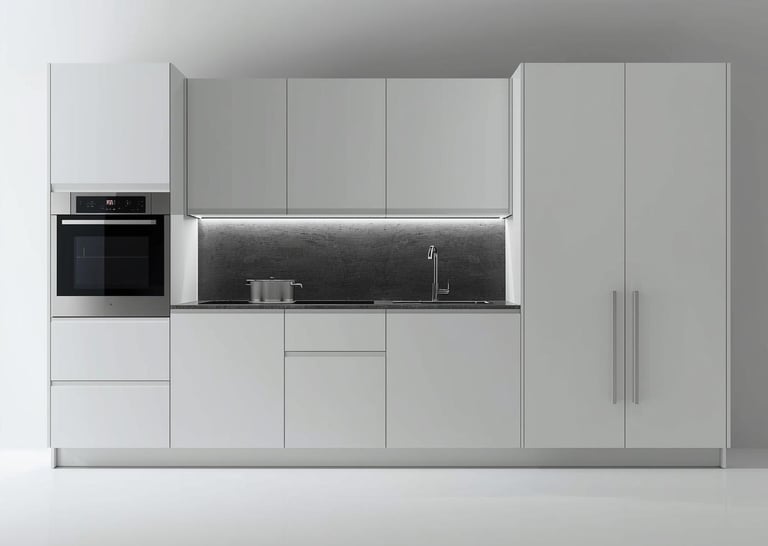
Free kitchen unit calculator. Calculate cabinet dimensions, countertop square footage, appliance clearances, and unit conversions for your kitchen remodel. Plan layouts, estimate materials, and avoid costly measurement errors. No signup needed.
© 2026 Numovix. All rights reserved.
Calculators Categories
Digital & Tech
Converters Categories