

Inflation Calculator
INTRODUCTION
Inflation is silent.
It does not knock on your door.
It does not send you a warning letter.
But every single year, it quietly steals a piece of your money's value.
That $100 in your wallet today?
In 10 years, it might only buy what $75 buys now.
In 20 years, maybe $55.
In 30 years, perhaps $40.
This is not theory.
This is the real cost of inflation — and most people completely ignore it.
An inflation calculator shows you the truth.
It reveals how much prices will rise.
How much your savings will shrink.
And how much you actually need to earn just to stay in the same place.
In 2026, global inflation rates vary wildly.
Some countries face 2-3% annual inflation.
Others battle 20%, 50%, or even hyperinflation above 100%.
Understanding inflation is not optional anymore.
It is essential for survival — for your savings, your salary, your investments, and your retirement.
---
WHAT IS INFLATION?
Inflation is the rate at which the general level of prices for goods and services rises over time.
When inflation is 5%, something that costs $100 today will cost approximately $105 next year.
That same item will cost:
• Year 2: $110.25
• Year 5: $127.63
• Year 10: $162.89
• Year 20: $265.33
• Year 30: $432.19
Your money is losing value even when you are not spending it.
This is why keeping cash under your mattress — or in a low-interest savings account — is actually losing you money.
---
WHAT IS AN INFLATION CALCULATOR?
An inflation calculator is a tool that shows you:
• Future price: What will something cost in 10, 20, or 30 years?
• Purchasing power loss: How much less can you buy with the same money?
• Real return: What is your actual investment return after inflation?
• Salary needed: How much will you need to earn to maintain your lifestyle?
• Retirement shortfall: Will your savings actually last?
It answers the question everyone should ask but rarely does:
"Is my money growing faster than prices are rising?"
If the answer is no, you are getting poorer — even if your bank balance looks bigger.
---
HOW TO USE THE NUMOVIX INFLATION CALCULATOR
Our calculator gives you the complete inflation picture in under 30 seconds.
Step 1:
Enter the current amount.
This could be:
• A product's price today
• Your current monthly expenses
• Your current salary
• Your current savings balance
Step 2:
Enter the annual inflation rate.
Use realistic numbers:
• USA / Europe: 2% – 4%
• India: 4% – 6%
• Argentina / Turkey: 50% – 100%+ (hyperinflation)
• Global average: 3% – 5%
Step 3:
Enter the number of years.
Common planning horizons:
• Short-term: 3 – 5 years
• Medium-term: 10 – 15 years
• Long-term: 20 – 40 years (retirement planning)
Step 4:
Click "Calculate."
You will instantly see:
• Future price of the same item
• Purchasing power lost (percentage and dollar amount)
• Equivalent future salary needed
• Year-by-year breakdown showing gradual erosion
Pro Tip:
Run the calculator three times:
1. With official government inflation rate (often understated)
2. With your actual spending inflation (usually higher)
3. With 5% inflation as a stress test
The gap between these results will open your eyes.
---
THE INFLATION FORMULA
Understanding the math helps you verify results and plan independently.
Future Value Formula:
FV = PV × (1 + r)^t
Where:
• FV = Future value (what it will cost later)
• PV = Present value (what it costs today)
• r = Annual inflation rate (in decimal)
• t = Number of years
Purchasing Power Formula:
Purchasing Power = PV ÷ (1 + r)^t
This tells you what your current money will actually be worth in the future.
Real Return Formula:
Real Return = Nominal Return − Inflation Rate
If your investment earns 8% but inflation is 5%, your real return is only 3%.
Real Example:
A loaf of bread costs $3.00 today.
Inflation rate: 4% per year.
What will it cost in 20 years?
FV = 3.00 × (1 + 0.04)^20
FV = 3.00 × (1.04)^20
FV = 3.00 × 2.191
FV = $6.57
Your $3.00 today buys the same as $6.57 in 20 years.
If your salary does not double in 20 years, you are effectively earning less.
---
GLOBAL INFLATION SNAPSHOT 2026
Inflation affects every country differently.
Here is the current landscape:
| Country / Region | Inflation Rate 2026 | Impact Level |
| USA | 2.5% – 3.5% | Moderate |
| Eurozone | 2.0% – 3.0% | Moderate |
| United Kingdom | 2.5% – 4.0% | Moderate-High |
| India | 4.5% – 6.0% | High |
| China | 1.5% – 2.5% | Low |
| Brazil | 4.0% – 6.0% | High |
| Argentina | 100% – 250% | Hyperinflation |
| Turkey | 40% – 70% | Very High |
| Nigeria | 25% – 35% | Very High |
| Japan | 1.0% – 2.0% | Low |
| Australia | 2.5% – 4.0% | Moderate |
| South Africa | 5.0% – 7.0% | High |
What this means:
At 3% inflation, prices double every 24 years.
At 6% inflation, prices double every 12 years.
At 12% inflation, prices double every 6 years.
At 50% inflation, prices double every 1.4 years.
Your emergency fund, your retirement savings, your salary — all must grow faster than these numbers.
Or you are falling behind.
---
THE RULE OF 72 FOR INFLATION
The same rule that estimates investment doubling also estimates inflation's damage.
Years to double prices = 72 ÷ Inflation Rate
Examples:
• At 3% inflation: 72 ÷ 3 = 24 years for prices to double
• At 6% inflation: 72 ÷ 6 = 12 years for prices to double
• At 12% inflation: 72 ÷ 12 = 6 years for prices to double
This is why long-term planning is critical.
Your $1 million retirement fund today?
At 3% inflation over 30 years, you need $2.43 million to buy the same lifestyle.
If you only saved $1 million, you are $1.43 million short — even though the number looks big.
---
REAL-WORLD SCENARIOS
Scenario 1: Retirement Planning
Robert is 40 years old.
He plans to retire at 65 with $1,000,000 saved.
He assumes 3% annual inflation.
What will $1,000,000 actually buy in 25 years?
Purchasing Power = $1,000,000 ÷ (1.03)^25
Purchasing Power = $1,000,000 ÷ 2.094
Purchasing Power = $477,600
Robert's $1 million will feel like less than $478,000 in today's money.
He needs to either:
• Save $2.1 million instead
• Earn higher returns above inflation
• Reduce retirement lifestyle expectations
---
Scenario 2: College Education Fund
Sarah wants to save for her newborn's college.
Current 4-year college cost: $100,000.
College inflation: 5% per year (education rises faster than general inflation).
Time until college: 18 years.
Future Cost = $100,000 × (1.05)^18
Future Cost = $100,000 × 2.407
Future Cost = $240,700
Sarah needs $240,700 — not $100,000.
If she only saves $100,000, she covers less than half.
---
Scenario 3: Salary Negotiation
Mike earns $60,000 per year.
Inflation is 4% annually.
To maintain purchasing power, what should his salary be in 5 years?
Required Salary = $60,000 × (1.04)^5
Required Salary = $60,000 × 1.217
Required Salary = $73,020
If Mike's salary is only $65,000 after 5 years, he is effectively earning $11,000 less in real terms.
He should negotiate raises based on inflation + merit, not just merit alone.
---
Scenario 4: Emergency Fund Erosion
Lisa keeps $20,000 in a savings account earning 0.5% interest.
Inflation is 3.5%.
Real return = 0.5% − 3.5% = −3.0%
Every year, Lisa loses $600 in purchasing power.
After 10 years:
• Nominal balance: $21,023
• Real value in today's money: $14,180
Lisa thinks she is being safe.
She is actually losing $5,820 in purchasing power.
Her "safe" emergency fund is bleeding value.
---
WHY EVERYONE NEEDS AN INFLATION CALCULATOR
1. Your Savings Are Shrinking
Money in a savings account at 2% interest with 4% inflation?
You are losing 2% per year in real terms.
The calculator shows exactly how much.
2. Your Salary Raise Is Not a Raise
Got a 3% raise with 5% inflation?
That is a 2% pay cut in real terms.
Use the calculator to know what raise you actually need.
3. Retirement Numbers Are Misleading
$1 million sounds impressive.
But in 30 years at 3% inflation, it buys what $411,000 buys today.
The calculator converts fantasy numbers into reality.
4. Investment Returns Are Not What They Seem
Your stock portfolio returned 10%.
Inflation was 6%.
Your real return was 4%.
The calculator separates nominal gains from actual wealth growth.
5. Long-Term Contracts Are Dangerous
Locked into a 5-year lease at fixed rent?
Great if inflation rises.
Locked into a 5-year salary freeze?
Disaster if inflation rises.
The calculator shows which side of the trade you are on.
---
KEY FACTORS THAT AFFECT INFLATION IMPACT
Country of Residence:
Developed nations (USA, Europe, Japan) typically see 2-4% inflation.
Emerging markets (India, Brazil, South Africa) often face 5-8%.
Crisis economies (Argentina, Turkey, Venezuela) experience 50-500%+.
Spending Basket:
Official inflation uses an average basket.
Your personal inflation may differ.
If you spend more on:
• Healthcare: Your inflation is higher (medical costs rise faster)
• Education: Your inflation is higher
• Technology: Your inflation is lower (tech gets cheaper)
• Housing: Depends on rent vs buy, location
Income Growth:
If your salary rises faster than inflation, you win.
If not, you lose — even with a "raise."
Investment Returns:
Cash loses to inflation.
Bonds may keep pace.
Stocks historically beat inflation over long periods.
Real estate often tracks or beats inflation.
Central Bank Policy:
Interest rate hikes fight inflation but slow economic growth.
Rate cuts stimulate growth but risk higher inflation.
Your savings, loans, and investments are all affected.
---
COMMON MISTAKES PEOPLE MAKE WITH INFLATION
Mistake 1: Ignoring Inflation Completely
"I saved $500,000 for retirement. I am set."
At 3% inflation over 25 years, that $500,000 buys what $233,000 buys today.
You are not set.
You are half set.
Mistake 2: Using Official Inflation Rates Blindly
Government inflation figures often understate reality.
Housing, healthcare, and education costs usually rise faster than the official CPI.
Use the calculator with your actual spending increases, not just government numbers.
Mistake 3: Keeping Too Much Cash
Emergency funds need liquidity.
But keeping 50% of your wealth in cash?
That is guaranteed wealth destruction during inflation.
The calculator shows exactly how much you are losing.
Mistake 4: Not Adjusting Retirement Targets
You calculated needing $1 million at age 65.
That was 10 years ago.
With inflation, you now need $1.34 million — and rising.
Recalculate every year.
Mistake 5: Accepting Low Raises
A 2% raise with 4% inflation is a pay cut.
Never negotiate salary without knowing the inflation rate.
The calculator shows your real income trend.
Mistake 6: Ignoring Inflation in Investment Planning
Your financial advisor projects 8% returns.
But what is the real return after 4% inflation?
Only 4%.
That changes every investment decision.
---
PRO TIPS TO BEAT INFLATION
Tip 1: Invest in Assets That Outpace Inflation
Historical inflation beaters:
• Stocks: 7-10% average annual return (beats 3% inflation)
• Real estate: Tracks or exceeds inflation long-term
• Commodities: Gold, oil, agricultural products rise with inflation
• Inflation-protected bonds: TIPS (USA), I-Bonds, inflation-indexed gilts (UK)
Avoid keeping large amounts in cash or low-yield savings long-term.
Tip 2: Negotiate Inflation-Linked Raises
Do not accept fixed-percentage raises.
Ask for inflation + performance.
If inflation is 5% and you performed well, ask for 7-8%.
Tip 3: Lock in Fixed-Rate Debt
Mortgages and loans at fixed rates become cheaper in real terms during inflation.
Your payment stays $1,500.
But your salary rises with inflation.
That $1,500 becomes a smaller percentage of your income over time.
Tip 4: Buy Durable Goods Before Prices Rise
If you know prices will rise 10% next year, buying a car, appliance, or furniture now saves money.
The calculator shows exactly how much waiting costs you.
Tip 5: Invest in Yourself
The best inflation hedge is earning power.
Skills, education, and certifications raise your income faster than inflation.
Your salary is your biggest asset — protect and grow it.
Tip 6: Use Inflation-Protected Accounts
• USA: I-Bonds (currently ~5%+, inflation-adjusted), TIPS
• UK: Index-linked gilts, NS&I inflation bonds
• India: Inflation-indexed bonds, PPF (tax-free, ~7-8%)
• Global: TIPS ETFs, inflation-linked bond funds
These guarantee your purchasing power does not shrink.
Tip 7: Rebalance Annually
Inflation changes which investments perform best.
Review your portfolio yearly.
Shift from cash to growth assets when inflation rises.
Shift to stability when inflation falls.
---
QUICK SUMMARY
Before you use the calculator, remember these key points:
• Inflation silently destroys purchasing power — 3% annually halves your money's value in 24 years
• Official inflation rates often understate your personal cost increases
• Real return = nominal return minus inflation — a 7% investment with 4% inflation only gains 3%
• Cash and low-yield savings lose value during inflation — invest in growth assets
• Retirement targets must be inflation-adjusted — $1 million today is not $1 million in 30 years
• Salary raises below inflation are pay cuts — always negotiate with real returns in mind
• Fixed-rate debt becomes cheaper during inflation — do not rush to pay off low-rate loans
• The Rule of 72 estimates doubling time: 72 ÷ inflation rate = years until prices double
---
FREQUENTLY ASKED QUESTIONS
Q1: What is the difference between inflation and deflation?
Inflation: Prices rise, money loses value.
Deflation: Prices fall, money gains value.
Deflation sounds good but is economically dangerous — people delay spending, businesses fail, unemployment rises.
Moderate inflation (2-3%) is considered healthy for economic growth.
---
Q2: How does inflation affect my mortgage?
If you have a fixed-rate mortgage, inflation helps you.
Your payment stays the same while your income rises.
The real burden of your debt shrinks over time.
If you have an adjustable-rate mortgage (ARM), inflation hurts you.
Rising inflation usually leads to rising interest rates — and higher payments.
---
Q3: Is gold a good hedge against inflation?
Gold has historically preserved purchasing power over very long periods (50+ years).
But in shorter timeframes (5-10 years), gold prices can be volatile and may not track inflation closely.
It is a partial hedge, not a perfect one.
Diversification is better than relying on any single asset.
---
Q4: Should I pay off debt or invest during high inflation?
Mathematical answer: If your debt interest is below expected investment returns (after inflation), invest.
Example: Mortgage at 4%, inflation at 5%, investments expected at 8%.
Real mortgage cost = 4% − 5% = −1% (you are being paid to borrow!)
Real investment return = 8% − 5% = 3%
Invest, do not prepay.
But if debt is at 18% (credit cards), pay it off regardless.
---
Q5: How do I protect my retirement from inflation?
• Calculate retirement needs using inflation-adjusted numbers
• Invest in growth assets (stocks, real estate) that beat inflation
• Consider inflation-adjusted annuities or withdrawal strategies
• Delay Social Security / pension claims if possible — payments increase with inflation delays
• Keep some inflation-protected bonds in your portfolio
• Plan for healthcare inflation (6-8% annually) separately from general inflation
---
Q6: Why does the government say inflation is 3% but my costs feel higher?
Official inflation measures an average basket of goods.
Your personal basket may include:
• More healthcare (rising faster)
• More education (rising faster)
• More housing (rising faster in your city)
• Less technology (getting cheaper)
Also, governments sometimes understate inflation for political and economic reasons.
Use the calculator with your actual cost increases for accurate planning.
---
Q7: What is hyperinflation and should I worry about it?
Hyperinflation is inflation above 50% per month.
Examples: Zimbabwe 2008, Venezuela 2018, Germany 1923, Argentina ongoing.
In hyperinflation:
• Prices double in weeks or days
• Savings become worthless
• People spend money immediately before it loses value
• Foreign currency and hard assets (gold, real estate) become stores of value
Most developed nations are not at risk of hyperinflation.
But emerging markets and crisis economies face this threat regularly.
If you live in a high-inflation country, convert savings to stable foreign currency or hard assets immediately.
---
RELATED CALCULATORS
Explore our full suite of free financial tools:
• Compound Interest Calculator
• Simple Interest Calculator
• Retirement Calculator
• Savings Goal Calculator
• Investment Return Calculator
• Mortgage Calculator
• Loan EMI Calculator
• Real Return Calculator
• Purchasing Power Calculator
---
FINAL THOUGHTS
Inflation is the invisible tax.
It does not appear on your bank statement.
It does not trigger any alerts.
But year after year, it quietly confiscates your wealth.
The $50,000 you saved?
In 20 years at 4% inflation, it buys what $22,800 buys today.
The $100,000 salary you are proud of?
In 10 years at 3% inflation, you need $134,000 just to maintain your lifestyle.
An inflation calculator is not just a number tool.
It is a reality check.
It forces you to ask:
"Am I actually getting richer? Or just running faster to stay in the same place?"
The answer determines everything.
Your savings rate.
Your investment strategy.
Your salary negotiations.
Your retirement plan.
Whether you live in New York with 3% inflation or Buenos Aires with 100% inflation, the rule is the same:
Grow your money faster than prices grow. Or accept that you are getting poorer.
Run the numbers. Face the truth. Adjust your plan.
Your future purchasing power depends on it.
---
DISCLAIMER
This article is for educational and informational purposes only.
Inflation rates, economic conditions, and government policies change frequently and unpredictably.
The examples provided are illustrative and based on approximate 2026 market conditions and historical averages.
Actual inflation in your country, city, and personal spending basket may differ significantly from official figures.
Always consult a certified financial planner, economist, or investment advisor before making significant financial decisions based on inflation projections.
Numovix does not provide financial or investment advice.
Our calculator results should be verified with current economic data and professional guidance before making any commitment.
Past inflation trends do not guarantee future inflation rates.
Inflation Calculator | Calculate Future Value & Purchasing Power | Numovix
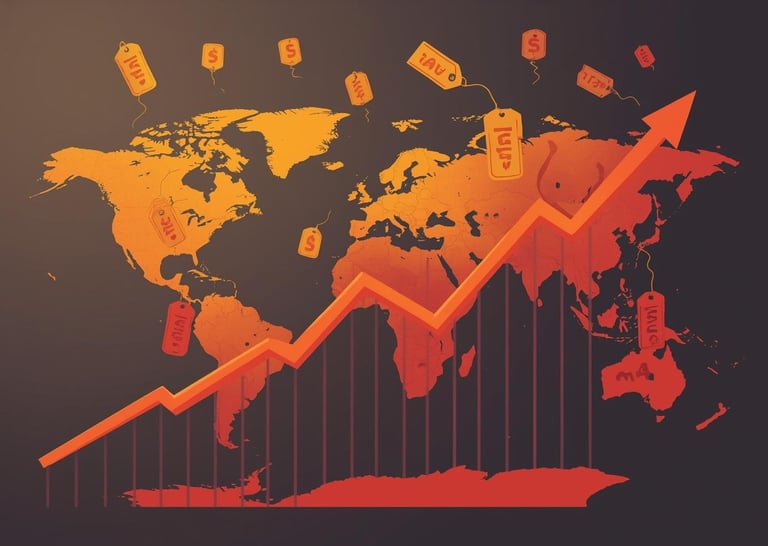

Free inflation calculator. See how inflation erodes your money's value over time. Calculate future prices, real returns, and purchasing power loss. No signup needed.
© 2026 Numovix. All rights reserved.
Calculators Categories
Digital & Tech
Converters Categories