

Hydraulic Cylinder Calculator
The Hydraulic Cylinder Calculator: A Field Manual for American Shops
Stop Guessing and Start Knowing What Your Cylinder Can Actually Do
A practical, no-nonsense guide to hydraulic cylinder calculations written for American mechanics, fabricators, and equipment operators who need real answers from real math.
If you have ever stood in front of a dead log splitter or a dump bed that refuses to rise, you already know the feeling. You have got a cylinder that looks fine, a pump that sounds fine, and a stack of hoses that are not leaking. But nothing moves the way it should. Somewhere between the engine and the work, the math stopped working. That is where a hydraulic cylinder calculator stops being a website tool and starts being the closest thing you have to a shop manual for reality.
Most guys in this trade learn hydraulics with their hands first and their brains second. You learn that more oil means faster movement. You learn that a bigger piston pushes harder. You learn that 3,000 psi sounds like a lot until you are trying to lift twelve tons of scrap steel and the cylinder just sits there hissing. The calculator bridges that gap. It takes what your hands know and gives it numbers your brain can use to make decisions.
This is not an engineering textbook. You will not find differential equations here or charts written for PhD candidates. This is a field manual for the American shop. Whether you are rebuilding a cylinder on a John Deere planter in Iowa, troubleshooting a garbage truck packer in Ohio, or building a custom press in a Texas fabrication shop, the math is the same.
Before you punch numbers into any calculator, you need to know what you are measuring. A hydraulic cylinder is not complicated, but every part has a name and every name affects the math.
The bore is the inside diameter of the cylinder barrel. In American shops, this is measured in inches. Common bores run from two inches up to six or eight on heavy equipment, though you will see twelve-inch monsters on mining gear. The bore matters because it determines how much surface area the hydraulic oil has to push against. More area means more force, assuming your pressure stays constant.
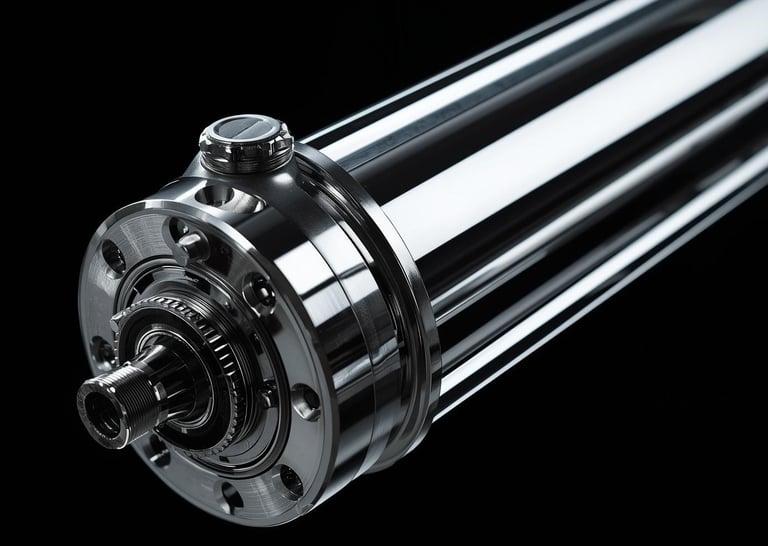
The rod is the shiny steel shaft that extends out of the cylinder. Rod diameter matters because it takes up space inside the barrel on the rod side of the piston. When you retract the cylinder, the oil is pushing on a smaller effective area because the rod is in the way. That means your retract force is always less than your extend force. A lot of guys forget this and wonder why the cylinder lifts a load fine but struggles to pull something.
Stroke is how far the rod travels from fully retracted to fully extended. This is simple distance, but it drives two other numbers you care about: cycle time and oil volume. A longer stroke means more oil has to move in and out, which means your pump needs to deliver more gallons per minute to keep the speed reasonable.
Here is the math that matters. Force equals pressure times area. F = P × A. That is it. Everything else is just rearranging this same relationship.
In American units, pressure is measured in pounds per square inch, or psi. Area is measured in square inches. Multiply them together and you get force in pounds. If your cylinder has a four-inch bore, the area is π times the radius squared. The radius is two inches. Two squared is four. Four times pi is roughly 12.57 square inches. At 2,500 psi, that cylinder generates about 31,400 pounds of force. That is fifteen and a half tons. Most people dramatically underestimate what a mid-sized cylinder can do.
The rod side calculation works the same way, but you subtract the rod area from the piston area. Say you have a two-inch rod on that same four-inch bore cylinder. The rod area is π times one squared, or about 3.14 square inches. Subtract that from 12.57 and you get 9.43 square inches. At the same 2,500 psi, your retract force is about 23,600 pounds. Still plenty for most jobs, but noticeably less.
This is where the calculator earns its keep. You can play with the numbers before you buy a cylinder or redesign a system. If you need twenty tons of push and your pump maxes out at 2,000 psi, you know immediately that a four-inch bore will not cut it. You need at least a five-inch bore, which gives you about 19.6 square inches of area and 39,300 pounds at 2,000 psi. The calculator lets you iterate without welding or buying parts you will return on Monday morning.
Speed calculation is the other half. Speed equals flow rate divided by area. In American shops, flow is gallons per minute, or GPM. But the formula needs cubic inches per minute, so you multiply GPM by 231. Then divide by the area in square inches.
Let us stick with that four-inch bore. If your pump delivers ten GPM, that is 2,310 cubic inches per minute. Divide by 12.57 and you get about 184 inches per minute, or a little over three inches per second. But if you need to cycle a ten-inch stroke every five seconds, the math tells you that you need more flow or a smaller bore. The calculator makes that obvious before your customer starts asking why the machine is slow.
The calculator gives you clean numbers. The real world gives you losses, heat, and surprises. Understanding where the math diverges from reality will save you more time than any online tool.
Pump pressure is not cylinder pressure. Your pump might be rated for 3,000 psi, but by the time the oil runs through twenty feet of hose, four fittings, a flow control valve, and a filter, you have lost something. On a well-maintained system, you might see a 5 to 10 percent drop. On a neglected system with old hoses and dirty oil, you could lose 20 percent or more. The calculator assumes all the pressure makes it to the piston. Your job is to know whether that assumption is true.
Backpressure is the silent killer. When oil leaves the cylinder, it has to go somewhere. If the return line is restricted, if the valve is not fully open, or if the filter is clogged, the oil on the rod side pushes back. That resistance subtracts from your available force. It also creates heat, which thins the oil, which makes leaks worse. A calculator cannot smell burnt oil or feel a hot valve body. You can.
System relief valve settings matter too. Most American-built machines have the relief set somewhere between 2,000 and 3,000 psi. That is your hard ceiling. It does not matter what the pump is capable of or what the cylinder is rated for. When the relief opens, the party stops. If your calculation says you need 2,800 psi but your relief cracks at 2,500, you are not getting the force you expect. You either need a bigger cylinder or a higher relief setting, and only one of those is safe to change without understanding the whole system.
Every time your cylinder extends and retracts, it moves oil from the tank to the cylinder and back again. The volume of that oil is easy to calculate, but easy to forget.
Volume equals area times stroke length. For our four-inch bore with a ten-inch stroke, the extend volume is 12.57 square inches times ten inches, or about 126 cubic inches. That is roughly half a gallon. The retract volume is less because the rod takes up space. With a two-inch rod, the retract volume is 9.43 square inches times ten inches, or about 94 cubic inches. Just over a third of a gallon.
Why does this matter? Because your reservoir has to be big enough to handle it without sucking air. If your tank only holds two gallons and you have two large cylinders cycling simultaneously, you can starve the pump. The calculator will tell you the cylinder volume. You have to look at the tank and ask if there is enough oil above the suction line to keep the pump happy.
A calculator is a liar by omission. It tells you the truth about the numbers you feed it, but it stays quiet about the numbers you forgot.
It does not know about side loading. A hydraulic cylinder is designed to push straight in and pull straight out. When you mount it at an angle, when the load shifts, or when the pivot pins wear oval, the rod starts to bend. That bend creates drag inside the seals. The cylinder needs more pressure to move the same load. The calculator says 2,000 psi should do it. The gauge says 2,400. The difference is friction from a bent rod and a scored barrel.
It does not know about seal condition. New seals glide. Old seals grip. A cylinder with hardened, cracked packings can lose 15 percent of its force just to internal friction. You might calculate that you need a three-inch bore and buy a beautiful new cylinder, only to find that your old cylinder of the same size was not broken, it was just tired. The calculator cannot measure wear.
It does not know about your oil. The calculations assume standard hydraulic oil at standard viscosity. If you are running the wrong weight, if the oil is contaminated with water or grit, or if someone topped off the tank with motor oil because the hydraulic drum was empty, the numbers change. Enough to matter when you are working at the margins.
The best calculator is the one you keep in your head, backed up by a folded piece of paper in your toolbox. After twenty years in a shop, most veteran mechanics can estimate cylinder force within ten percent just by looking at the bore and the gauge. That is not magic. It is pattern recognition, and you can build it faster than you think.
Start with the squares. A two-inch bore has an area of about 3.14 square inches. A three-inch bore is about 7.07. Four inches is 12.57. Five inches is 19.63. Six inches is 28.27. Memorize those five numbers and you can estimate anything in between. At 1,000 psi, the force in pounds is just the area times a thousand. At 2,000 psi, double it. At 3,000 psi, triple it. A five-inch bore at 2,500 psi is 19.63 times 2,500, which is roughly 49,000 pounds. Call it twenty-four tons and you are close enough to know if your rigging is adequate.
Do the same for common rod sizes. A one-inch rod is 0.79 square inches. One and a half inches is 1.77. Two inches is 3.14. Two and a half is 4.91. Three inches is 7.07. When you need retract force, subtract the rod area from the bore area and multiply by pressure. It takes thirty seconds with a notepad and saves you from guessing.
Write down your own cheat sheet for flow rates. Ten GPM is 2,310 cubic inches per minute. Fifteen GPM is 3,465. Twenty GPM is 4,620. If you know your cylinder area, you can estimate speed in your head. A six-inch bore has an area of about 28 square inches. At twenty GPM, that is 4,620 divided by 28, which is roughly 165 inches per minute. Under three inches per second. Is that fast enough for your application? Now you know before you plumb a single fitting. Write these numbers on tape inside your toolbox lid. After a month, they will stick.
Keep a running log of the machines you work on. Note the bore, stroke, rod size, operating pressure, and actual cycle time. After a while you will see the patterns. You will know that a typical three-inch bore garbage truck cylinder runs at 2,200 psi and cycles in about eight seconds. You will know that a two-and-a-half-inch bore log splitter cylinder at 2,500 psi generates about twelve tons, which is plenty for seasoned oak but might struggle with a gnarled hickory knot. That knowledge is worth more than any app because it includes the real-world fudge factors that no calculator provides. That fluency separates parts changers from mechanics.
Hydraulic cylinders are everywhere in American industry, and the math looks different depending on where you stand.
In agriculture, a farmer in Kansas might rebuild the lift cylinders on a thirty-year-old grain combine. The original cylinders have three-inch bores and sixteen-inch strokes, running off the tractor's central hydraulic system at maybe 2,000 psi. The calculator says each cylinder generates about 14,000 pounds of lift. That sounds like plenty until you realize the combine header weighs eight thousand pounds and the geometry of the linkage means the cylinder is only effective at a thirty-degree angle during part of the cycle. The actual vertical lift is closer to half the raw cylinder force. The calculator gives you the starting point. The linkage angle gives you the reality.
In construction, a contractor in Arizona might be troubleshooting an excavator bucket cylinder. The machine specs say five-inch bore, three-and-a-half-inch rod, thirty-two-inch stroke, running at 3,000 psi. The extend force should be around thirty-seven tons. But the bucket will not curl under load. The calculator says the cylinder is strong enough. The field says otherwise. After checking the math, the mechanic finds a leaking crossover relief valve in the circuit. The cylinder is fine. The math was fine. The valve was bleeding pressure back to tank. This is why the calculator is only one tool in the box.
In manufacturing, a press shop in Michigan runs a custom hydraulic press for forming automotive brackets. The cylinder is an eight-inch bore, six-inch rod, twelve-inch stroke, fed by a 25-horsepower power unit. At 2,000 psi, the press generates over fifty tons. The calculator confirms the tonnage. But the shop manager also needs to know the dwell time, the decompression cycle, and how much heat the unit generates during a ten-hour shift. Those questions take the calculator into territory where experience matters more than formulas.
Most people think of a hydraulic cylinder calculator as a design tool for building new systems. It is just as valuable for fixing old ones.
When a cylinder is slow, the calculator helps you isolate the problem. You measure the actual cycle time with a stopwatch. You check the pump flow with a flow meter. You plug the bore, stroke, and flow into the calculator and see what the speed should be. If the calculated speed is four inches per second and the actual speed is one inch per second, you have a restriction somewhere. It could be a pinched hose, a partially closed valve, or internal leakage past the piston seals. The calculator does not tell you which. It tells you that the math does not match reality, which is the first step toward finding the fault.
When a cylinder lacks force, the calculator does the same diagnostic work. You know the bore and the operating pressure. You calculate the expected force. Then you put a gauge on the work port and measure the actual pressure while the cylinder stalls. If the gauge reads 2,000 psi but the cylinder should generate twenty tons at that pressure, and it is only lifting twelve tons before stalling, you have internal leakage. The oil is bypassing the piston instead of pushing it. The math proves the cylinder is sick, not the pump or the valve.
When a system overheats, the calculator helps you understand if the power unit is sized correctly. Heat comes from inefficiency, and inefficiency often comes from mismatch. If your calculator shows that your pump is delivering twice the flow your cylinders can use at the rated pressure, the excess flow is going over the relief valve. That creates pure heat. The math shows you are throwing horsepower away. You either need smaller pumps, larger cylinders, or a variable displacement system. The calculator turns a thermal problem into a sizing problem.
A hydraulic cylinder calculator is not a replacement for experience. It is a way to organize experience so you can make better decisions faster. It turns hunches into numbers and numbers into actions.
In the American shop, time is money and guessing is expensive. A cylinder that is too small means a machine that cannot do the job. A cylinder that is too big means wasted money, wasted space, and a power unit working harder than it needs to. A cycle time that is too slow kills productivity. A cycle time that is too fast creates impact loads, water hammer, and premature failure. The calculator sits in the middle of all those decisions and gives you a baseline.
The best mechanics do not calculate because they cannot figure it out by feel. They calculate because feel is not enough when you are ordering a four-thousand-dollar cylinder or explaining to a customer why their press needs a larger power unit. The numbers give you confidence. They give the customer confidence. They turn a conversation from "I think" into "I know." Carry that knowledge onto the job site and into every conversation where someone asks if the machine can handle the load.
Keep a calculator bookmarked on your phone. Keep a notepad in your toolbox with the basic formulas written down. Better yet, memorize the common bore areas and the relationship between GPM and cubic inches. The more fluent you are in the math, the faster you move through problems. And in a busy shop from California to Maine, that speed is what separates a good day from a bad one.
The cylinder does not care about your assumptions. It only cares about pressure, area, and flow. Learn the math, trust the math, and let the math do the heavy lifting. That is what the manual would say if it could talk.
© 2026 Numovix. All rights reserved.
Calculators Categories
Digital & Tech
Converters Categories