

Break-Even Point calculator
INTRODUCTION
Every business has a moment of truth.
A single point where everything changes.
Before this point, you are losing money.
After this point, you are making money.
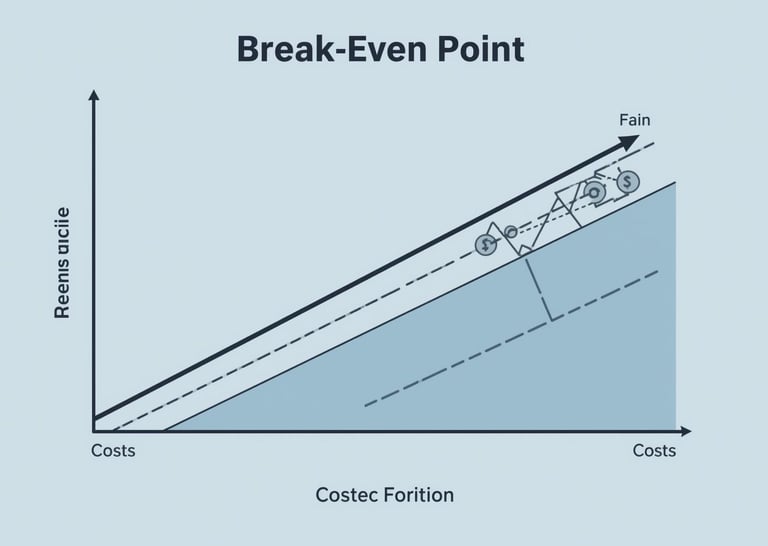
This is the break-even point.
It is the most important number most entrepreneurs never calculate.
They launch products without knowing how many they need to sell.
They open stores without knowing how much revenue they need.
They hire staff without knowing if sales can support payroll.
And then they wonder why they run out of cash.
A break-even calculator prevents this disaster.
It shows you exactly how many units you must sell.
Exactly how much revenue you must generate.
Exactly how long until you stop bleeding and start breathing.
In 2026, with rising costs and fierce competition, knowing your break-even point is not optional.
It is the difference between survival and closure.
---
WHAT IS A BREAK-EVEN POINT CALCULATOR?
A break-even calculator is a tool that determines the exact moment when your total revenue equals your total costs.
At break-even:
• You are not making a profit.
• You are not making a loss.
• You are covering every dollar you spend.
Beyond break-even:
• Every additional sale is pure profit.
Below break-even:
• Every missing sale deepens your losses.
Standard inputs:
• Fixed costs (rent, salaries, insurance — costs that do not change with sales)
• Variable costs per unit (materials, shipping, commissions — costs that scale with each sale)
• Selling price per unit (what customers pay)
• Current monthly sales (optional, for runway calculation)
• Target profit (optional, for profit-target analysis)
Outputs you get:
• Break-even units (how many items to sell)
• Break-even revenue (total sales dollars needed)
• Contribution margin per unit (price minus variable cost)
• Contribution margin ratio (percentage of each sale that covers fixed costs)
• Time to break-even (based on current sales trajectory)
• Profit at various sales levels (what happens if you sell 10%, 25%, 50% more)
It answers the questions every business owner must answer:
"How many units do I need to sell to survive?"
"What revenue covers all my costs?"
"How long until I stop losing money?"
"What happens if I raise prices or cut costs?"
---
HOW TO USE THE NUMOVIX BREAK-EVEN CALCULATOR
Our calculator gives you the complete break-even picture in under 60 seconds.
Step 1:
Enter your fixed costs per month (or year).
These are costs that stay the same regardless of sales:
• Rent or mortgage: $____
• Salaries and wages: $____
• Insurance: $____
• Software subscriptions: $____
• Loan payments: $____
• Utilities (base amount): $____
• Professional services (accountant, lawyer): $____
• Marketing (fixed portion): $____
Example: $15,000/month fixed costs
---
Step 2:
Enter your variable cost per unit.
These are costs that increase with each sale:
• Raw materials or product cost: $____
• Packaging: $____
• Shipping to customer: $____
• Sales commission: $____
• Payment processing fees: $____
• Direct labor per unit: $____
Example: $25 variable cost per unit
---
Step 3:
Enter your selling price per unit.
What does the customer pay?
Example: $75 per unit
---
Step 4:
Click "Calculate Break-Even."
You will instantly see:
• Contribution margin per unit: $75 − $25 = $50
• Contribution margin ratio: $50 ÷ $75 = 66.7%
• Break-even units: $15,000 ÷ $50 = 300 units/month
• Break-even revenue: 300 × $75 = $22,500/month
• Daily break-even: 300 ÷ 30 = 10 units/day
Pro Tip:
Run the calculator three times:
1. Current pricing and costs — see where you stand
2. With 10% price increase — see break-even drop
3. With 10% cost reduction — see break-eve drop further
Compare scenarios.
The results transform your pricing and cost strategy.
---
THE MATH BEHIND BREAK-EVEN ANALYSIS
Understanding the formulas helps you verify results and make strategic decisions.
---
Contribution Margin Per Unit:
Contribution Margin = Selling Price − Variable Cost Per Unit
This is the amount each sale contributes toward covering fixed costs.
Example:
Price: $100
Variable cost: $40
Contribution margin: $100 − $40 = $60
Every unit sold puts $60 toward your $15,000 monthly fixed costs.
---
Contribution Margin Ratio:
CM Ratio = Contribution Margin ÷ Selling Price
CM Ratio = $60 ÷ $100 = 60%
For every $1 in revenue, $0.60 covers fixed costs and eventually profit.
---
Break-Even Units:
Break-Even Units = Fixed Costs ÷ Contribution Margin Per Unit
Break-Even Units = $15,000 ÷ $60 = 250 units
You must sell 250 units to cover all costs.
Sell 251 and you profit $60.
Sell 249 and you lose $60.
---
Break-Even Revenue:
Break-Even Revenue = Fixed Costs ÷ Contribution Margin Ratio
Break-Even Revenue = $15,000 ÷ 0.60 = $25,000
Or simply: 250 units × $100 = $25,000
---
Break-Even with Target Profit:
Units for Target Profit = (Fixed Costs + Target Profit) ÷ Contribution Margin
You want $10,000 monthly profit.
Units = ($15,000 + $10,000) ÷ $60
Units = $25,000 ÷ $60
Units = 417
Sell 417 units to cover costs AND make $10,000 profit.
---
Margin of Safety:
Margin of Safety = Actual Sales − Break-Even Sales
You currently sell 400 units.
Break-even is 250 units.
Margin of safety = 400 − 250 = 150 units
Or as percentage: 150 ÷ 400 = 37.5%
You can lose 37.5% of sales before hitting losses.
Higher margin of safety = safer business.
---
Complete Real Example:
Maria's Handmade Jewelry Business:
Fixed Costs (Monthly):
• Studio rent: $800
• Equipment lease: $300
• Insurance: $200
• Website and software: $150
• Marketing (fixed): $500
• Owner salary (minimum draw): $2,000
Total Fixed: $3,950/month
---
Variable Costs Per Piece:
• Materials (silver, stones): $35
• Packaging: $5
• Shipping: $8
• Payment processing (3% of $120): $3.60
• Etsy fees (6.5% of $120): $7.80
Total Variable: $60.40 per piece
---
Selling Price: $120 per piece
---
Calculations:
Contribution Margin = $120 − $60.40 = $59.60
Contribution Margin Ratio = $59.60 ÷ $120 = 49.7%
Break-Even Units = $3,950 ÷ $59.60 = 66.3 pieces/month
Round up: 67 pieces/month
Break-Even Revenue = 67 × $120 = $8,040/month
Daily Break-Even = 67 ÷ 30 = 2.2 pieces/day
---
Analysis:
Maria needs to sell just 2-3 pieces per day to survive.
Currently she sells 90 pieces/month.
Margin of safety: 90 − 67 = 23 pieces (25.6%)
She is profitable but not by much.
A slow month (60 pieces) puts her in the red.
Strategies to improve:
• Raise price to $140 → Break-even drops to 55 pieces
• Reduce material cost to $30 → Break-even drops to 59 pieces
• Increase marketing to boost sales → Grow margin of safety
---
BREAK-EVEN ACROSS DIFFERENT BUSINESS MODELS
Restaurant:
• Fixed costs: $25,000/month (rent, staff, utilities)
• Variable cost per meal: $8 (food, packaging)
• Average meal price: $25
• Contribution margin: $17
• Break-even: 1,471 meals/month = 49 meals/day
At 50 seats, 2 turns/day = 100 customers possible.
Break-even is achievable but tight.
---
SaaS Business:
• Fixed costs: $40,000/month (developers, servers, office)
• Variable cost per customer: $5 (hosting, support)
• Monthly subscription price: $99
• Contribution margin: $94
• Break-even: 426 customers
At current growth of 50 customers/month, break-even in 9 months.
Need $360,000 funding to survive until then.
---
Freelance Consultant:
• Fixed costs: $2,500/month (software, coworking, insurance, personal expenses)
• Variable cost per project: $100 (tools, subcontractor)
• Average project fee: $2,000
• Contribution margin: $1,900
• Break-even: 1.3 projects/month
Round up: 2 projects/month
One project = losing money.
Two projects = profitable.
Three projects = $3,800 profit.
Very lean, very scalable.
---
Retail Store:
• Fixed costs: $12,000/month (rent, staff, utilities)
• Average variable cost per item: $30
• Average selling price: $60
• Contribution margin: $30
• Break-even: 400 items/month = 13 items/day
At $60 average, break-even revenue = $24,000/month
If store traffic is 30 customers/day with 20% conversion = 6 sales/day.
Not enough.
Need higher prices, lower costs, or more traffic.
The calculator exposes this before lease is signed.
---
WHY EVERY BUSINESS NEEDS A BREAK-EVEN CALCULATOR
1. Validate Business Ideas Before Launch
You want to open a coffee shop.
Calculator shows you need 150 customers/day at $8 average.
Location foot traffic: 200 people/day.
Possible but risky.
Location foot traffic: 500 people/day.
Much safer.
Calculate before you sign the lease.
---
2. Set Sales Targets
Break-even gives you a concrete number.
"We need 50 units per week."
Not "we need more sales."
Specific targets drive specific actions.
---
3. Make Pricing Decisions
Current price: $50, break-even: 400 units.
New price: $60, break-even: 280 units.
20% price increase cuts break-even by 30%.
The calculator shows if demand can support the higher price.
---
4. Control Costs
Fixed costs too high? Break-even is unreachable.
Variable costs too high? Contribution margin shrinks.
The calculator identifies which cost category hurts most.
---
5. Plan Funding and Runway
Break-even in month 8?
Monthly burn: $20,000?
You need $160,000 minimum to survive.
The calculator links operations to funding needs.
---
KEY FACTORS THAT AFFECT BREAK-EVEN
Fixed Costs:
Higher fixed costs = higher break-even = more risk.
But also more capacity to scale.
A factory with $100,000 fixed costs breaks even high.
But once passed, profits explode.
A freelancer with $2,000 fixed costs breaks even low.
But max profit is capped by personal hours.
---
Variable Costs:
Lower variable costs = higher contribution margin = lower break-even.
Manufacturing efficiency, bulk discounts, and automation reduce variable costs.
---
Pricing Power:
Higher prices = higher contribution margin = lower break-even.
But only if customers accept the price.
Brand strength, uniqueness, and quality enable premium pricing.
---
Sales Volume:
More sales = reach break-even faster.
But volume requires marketing, distribution, and capacity.
---
Product Mix:
Multiple products with different margins complicate break-even.
Calculate weighted average contribution margin.
Example:
• Product A: 60% margin, 70% of sales
• Product B: 40% margin, 30% of sales
Weighted average = (0.60 × 0.70) + (0.40 × 0.30) = 0.42 + 0.12 = 54%
Use 54% for overall break-even calculation.
---
COMMON MISTAKES BUSINESS OWNERS MAKE
Mistake 1: Ignoring Hidden Fixed Costs
You count rent but forget:
• Your own salary
• Loan payments
• Software renewals
• Professional fees
Total all fixed costs — including paying yourself.
---
Mistake 2: Underestimating Variable Costs
You price at $100 with $40 materials.
But forget:
• Shipping: $8
• Packaging: $5
• Payment fees: $3
• Returns allowance: $4
True variable cost: $60, not $40.
Break-even jumps significantly.
---
Mistake 3: Using Gross Margin Instead of Contribution Margin
Gross margin includes some fixed costs.
Contribution margin is purely price minus variable cost.
Use contribution margin for accurate break-even.
---
Mistake 4: Not Updating Break-Even Regularly
Costs change. Prices change. Product mix changes.
Recalculate monthly or quarterly.
A break-even from launch day is obsolete by month six.
---
Mistake 5: Confusing Break-Even with Profitability
Break-even means zero profit.
You are surviving, not thriving.
Build target profit into your analysis.
---
Mistake 6: Ignoring Seasonality
Retail break-even in December is easy.
In January? Impossible.
Calculate monthly break-evens for seasonal businesses.
Plan cash reserves for low months.
---
Mistake 7: Single Product Thinking
Most businesses sell multiple products.
Calculate weighted average contribution margin across your portfolio.
High-margin products subsidize low-margin ones.
---
PRO TIPS TO LOWER YOUR BREAK-EVEN POINT
Tip 1: Reduce Fixed Costs
• Negotiate rent (3 months free, percentage rent)
• Start remote, not office
• Use contractors, not employees
• Share equipment or space
Every $1,000 reduction in fixed costs cuts break-even significantly.
---
Tip 2: Reduce Variable Costs
• Negotiate supplier discounts
• Buy in bulk
• Improve manufacturing yield
• Reduce waste and defects
• Automate repetitive tasks
A $5 reduction in variable cost on $50 contribution margin = 10% easier break-even.
---
Tip 3: Raise Prices Strategically
A 10% price increase with minimal volume loss dramatically lowers break-even.
Test on a customer segment first.
---
Tip 4: Focus on High-Margin Products
Promote products with 70% margin over products with 30% margin.
Shift product mix toward higher contribution.
---
Tip 5: Increase Average Transaction Value
Bundle products.
Upsell add-ons.
Offer premium versions.
Higher per-transaction value = fewer transactions needed to break even.
---
Tip 6: Convert Fixed to Variable
Instead of $5,000/month salaried staff, use $20/hour contractors.
Pay only when busy.
Reduces fixed costs, lowers break-even risk.
---
Tip 7: Track Weekly, Not Monthly
In early stages, cash moves fast.
Track sales vs break-even weekly.
Catch problems before they become crises.
---
QUICK SUMMARY
Before you use the calculator, remember these key points:
• Break-even is the moment revenue equals total costs — before this you lose, after this you profit
• Contribution margin = price minus variable cost — this is what covers fixed costs
• Lower break-even = safer business — reduce fixed costs and variable costs aggressively
• Higher prices lower break-even — if market accepts the increase
• Include all costs — your salary, loan payments, software, professional fees
• Update break-even monthly — costs and prices change constantly
• Add target profit to break-even — zero profit is survival, not success
• Seasonal businesses need monthly break-evens — not annual averages
• Product mix matters — calculate weighted average contribution margin
• Track weekly in early stages — cash runs out faster than you think
---
FREQUENTLY ASKED QUESTIONS
Q1: What is the difference between break-even point and payback period?
Break-even point: When monthly revenue covers monthly costs (ongoing).
Payback period: When total cumulative profit equals initial investment (one-time).
Both matter. Break-even keeps you alive. Payback makes investors happy.
---
Q2: Can I have multiple break-even points?
Yes, with stepped fixed costs.
Example:
• 0-100 units: $10,000 fixed costs
• 101-500 units: $15,000 fixed costs (need bigger space, more staff)
Break-even jumps when you cross capacity thresholds.
Plan for these steps.
---
Q3: How do I calculate break-even for a service business?
Use hours instead of units.
• Fixed costs: $8,000/month
• Hourly rate: $100
• Variable cost per hour: $20 (software, subcontractor portion)
• Contribution margin: $80/hour
• Break-even: $8,000 ÷ $80 = 100 billable hours/month
At 50% billable time, need 200 available hours = full-time work.
---
Q4: What is a good margin of safety?
• 10% or less: Dangerous, high risk
• 20-30%: Acceptable, monitor closely
• 40-50%: Healthy, comfortable buffer
• 60%+: Very strong, room to grow or absorb shocks
Aim for minimum 25% margin of safety.
---
Q5: Should I include my salary in fixed costs?
Absolutely yes.
If the business cannot pay you a living wage, you have a hobby, not a business.
Include market-rate salary for your role in fixed costs.
---
Q6: How does break-even apply to startups with no revenue yet?
Calculate time to break-even based on projected sales ramp.
Month 1: 0 sales
Month 2: 10 sales
Month 3: 30 sales
...
Month 8: reach break-even volume
You need 8 months of funding to survive.
The calculator links sales projections to funding requirements.
---
Q7: Can break-even analysis help with investor pitches?
Absolutely.
Investors want to know:
• How much to sell before profitability?
• How long until break-even?
• What is margin of safety?
The calculator generates the precise numbers investors demand.
---
RELATED CALCULATORS
Explore our full suite of free business tools:
• Profit Margin Calculator
• Business Startup Cost Calculator
• Pricing Calculator
• Cash Flow Calculator
• ROI Calculator
• Business Loan Calculator
• Inventory Turnover Calculator
• Customer Acquisition Cost Calculator
• Lifetime Value Calculator
---
FINAL THOUGHTS
Every business has a moment of truth.
A number.
A threshold.
A line in the sand.
Before it, you are burning cash, losing sleep, questioning everything.
After it, you are building momentum, hiring staff, planning growth.
That moment is the break-even point.
Most entrepreneurs never calculate it.
They guess. They hope. They pray.
And then they wonder why they failed.
A break-even calculator removes the guesswork.
It replaces hope with math.
It replaces prayer with planning.
It shows you exactly what you need to sell.
Exactly how much you need to earn.
Exactly when the bleeding stops and the building begins.
Whether you are selling handmade candles from your kitchen or manufacturing industrial equipment, the question is the same:
"How many units? How much revenue? How long until I am safe?"
The calculator answers all three.
Run the numbers.
Know your break-even.
Sell past it.
Build from there.
That is how businesses survive.
That is how businesses thrive.
---
DISCLAIMER
This article is for educational and informational purposes only.
Business costs, pricing, market conditions, and competitive dynamics vary significantly by industry, location, and change frequently.
The examples provided are illustrative and based on approximate 2026 market conditions.
Actual break-even points depend on:
• Accurate cost tracking
• Market acceptance of pricing
• Competitive pressures
• Economic conditions
• Operational execution
Always consult a certified public accountant (CPA), business advisor, or financial professional before making major pricing, cost, or strategic decisions.
Numovix does not provide business, tax, or investment advice.
Our calculator results are estimates and should be verified with actual financial data, professional guidance, and current market conditions before making any business commitment.
Business decisions carry risk — conduct thorough due diligence and seek professional advice tailored to your specific situation.
Break-Even Point Calculator | Find When Your Business Becomes Profitable | Numovix
Free break-even point calculator. Calculate units to sell, revenue needed, and time to profitability. Plan pricing, control costs, and make smarter business decisions. No signup needed.
© 2026 Numovix. All rights reserved.
Calculators Categories
Digital & Tech
Converters Categories