

Beam Deflection Calculator
INTRODUCTION
You built a loft in your garage.
You felt ambitious. You felt handy. You felt like four pieces of 2×12 lumber bolted together were "basically a steel beam."
The span was 18 feet. The load was a home gym, storage boxes, and your pride.
You lifted the first dumbbell rack. The floor held. You walked across it. It felt solid. For a week.
Then the drywall below started cracking in a straight line. The door beneath the loft began sticking. The floor had a 2-inch bounce in the center.
You blamed the drywall crew. "Bad taping."
You planed the door. You patched the cracks. You told yourself old houses settle.
Month three: You loaded 800 pounds of winter tires onto the loft.
The deflection became 3.5 inches. The door frame twisted. The ceiling light fixture pulled out of its box. The floor had a visible bowl in it.
You blamed the lumber yard. "Garbage wood."
But the real problem was the number.
You never calculated deflection. It did not know your 2×12s were actually 1.5×11.25 inches. It did not know 18 feet is a massive span for construction-grade lumber under 50 pounds per square foot. It did not know that a beam can be strong enough to not break but too weak to not sag.
Your beam was not failing in bending. It was failing in serviceability.
Deflection is the silent destroyer of buildings. It does not make a noise. It does not snap dramatically. It slowly pulls walls apart, cracks tile, pops drywall screws, and makes occupants feel unsafe on a bouncy floor.
A beam that sags L/180 (1 inch per 15 feet) feels like a trampoline. A beam at L/360 (1 inch per 30 feet) feels solid. At L/480, you forget the floor is even there.
Building codes require beams to survive loads without breaking. But they also enforce deflection limits so buildings remain usable, doors close, and windows do not bind.
A Beam Deflection Calculator finds that sag. It tells you the exact downward movement under load. The exact beam size you need. The exact code compliance status.
In 2026, with open-concept designs, heavy tile flooring, and DIY mezzanines built from YouTube confidence, knowing your beam deflection is not optional.
It is essential for every engineer, contractor, architect, and anyone who spans an opening with a piece of material.
---
WHAT IS A BEAM DEFLECTION CALCULATOR?
A Beam Deflection Calculator is a tool that calculates how much a structural beam will bend (sag) under a given load, span, material, and support condition.
It uses structural engineering principles and Euler-Bernoulli beam theory:
• Elastic Modulus (E) — Material stiffness. Steel resists bending 15× better than wood.
• Moment of Inertia (I) — Cross-section shape efficiency. A tall, thin beam deflects far less than a wide, flat one.
• Span Length (L) — The #1 driver of deflection. Deflection increases with L³ for point loads and L⁴ for distributed loads.
• Load Magnitude (P or w) — Force applied. Point load at mid-span causes 2.5× more deflection than the same load spread evenly.
• Support Conditions — Simply supported, cantilever, fixed-fixed, or propped.
Standard inputs:
• Beam material (Steel, Wood, Aluminum, Concrete, LVL, Glulam)
• Beam size / shape (W-beam, I-joist, 2×10, rectangular tube, custom dimensions)
• Span length (feet, meters, inches)
• Load type (Point load, Uniformly Distributed Load, Moment, or combined)
• Load magnitude (lbs, kips, N, kN, psf, kPa)
• Support type (Simply supported, Cantilever, Fixed-Fixed, Overhang)
• Deflection limit (L/360, L/240, L/180, or custom)
Outputs you get:
• Maximum deflection in inches, mm, or feet
• Deflection ratio (L/?) for code comparison
• Bending stress (σ) to check strength
• Required Moment of Inertia (I) to meet your limit
• Required Section Modulus (S) for strength
• Code compliance (Pass/Fail for IBC/IRC limits)
• Self-weight inclusion effect on total deflection
It answers the questions every builder asks:
"Will this beam bounce?"
"Why is my tile floor cracking?"
"Can I use wood or do I need steel?"
"Why does my deck feel like a diving board?"
---
HOW TO USE THE NUMOVIX BEAM DEFLECTION CALCULATOR
Our calculator gives you instant, accurate structural analysis in under 30 seconds.
Step 1:
Select your beam material and shape.
Example: Steel — W8×24 Wide Flange
---
Step 2:
Enter your span length.
Example: 20 feet (240 inches)
---
Step 3:
Select your support condition.
Example: Simply Supported (pinned at both ends)
---
Step 4:
Enter your load type and magnitude.
Example: Point Load at Center — 6,000 lbs
---
Step 5:
Enter your deflection limit or select a code standard.
Example: L/360 (standard for floors per IBC)
---
Step 6:
Click "Calculate Deflection."
You will instantly see:
Example: W8×24 Steel, 20 ft Span, 6,000 lb Center Load, Simply Supported
---
Deflection Results:
| Parameter | Value |
| Moment of Inertia (I) | 82.7 in⁴ |
| Section Modulus (S) | 20.9 in³ |
| Modulus of Elasticity (E) | 29,000 ksi |
| Maximum Deflection | 0.71 inches |
| Deflection Ratio | L/338 |
| L/360 Limit | 0.67 inches |
| Code Compliance | FAIL (slightly exceeds L/360) |
| Bending Stress | 17,200 psi |
| Yield Strength Utilization | 34% (safe) |
---
Recommendation:
| Beam Option | I (in⁴) | Deflection | L/? | Status |
| W8×24 | 82.7 | 0.71" | L/338 | FAIL |
| W8×31 | 110 | 0.53" | L/453 | PASS |
| W10×26 | 144 | 0.41" | L/585 | Excellent |
| W12×26 | 204 | 0.29" | L/827 | Overkill |
---
Key Numbers:
• Actual deflection: 0.71 inches (beam sags over half an inch in center)
• Code limit: 0.67 inches (L/360 for 20 ft)
• Failure mode: Not strength, but serviceability (too bouncy)
• Fix: Upsize to W8×31 or switch to W10×26 for stiffer feel
• Bending stress: Only 34% of yield — the beam will never break, but it fails comfort
---
Example: Wood Floor Joist — 2×12 SPF, 16 ft Span, UDL 50 psf Live + 15 psf Dead
| Parameter | Value |
| Actual dimensions | 1.5" × 11.25" |
| Moment of Inertia (I) | 178 in⁴ |
| E (Spruce-Pine-Fir) | 1,400 ksi |
| Total UDL | 65 psf × 16" spacing / 12 = 86.7 lb/ft |
| Maximum Deflection | 0.55 inches |
| L/360 Limit | 0.53 inches |
| Code Compliance | Marginal / FAIL |
| Bending Stress | 1,150 psi |
| Allowable Stress | 1,150 psi | (exact at limit) |
Recommendation: Use 2×12 at 12" spacing or upgrade to LVL 1.75×11.875" (I = 245 in⁴, E = 1,900 ksi) for zero-bounce performance.
---
THE MATH BEHIND BEAM DEFLECTION CALCULATION
Understanding the formulas helps you verify results and avoid structural failures.
---
Euler-Bernoulli Beam Equations:
Simply Supported Beam — Point Load at Center:
δ_max = (P × L³) / (48 × E × I)
Where:
• δ = Deflection (inches)
• P = Point load (pounds)
• L = Span (inches)
• E = Modulus of Elasticity (psi)
• I = Moment of Inertia (in⁴)
Example (W8×24, P=6,000 lb, L=240 in, E=29,000,000 psi, I=82.7 in⁴):
δ = (6,000 × 240³) / (48 × 29,000,000 × 82.7)
δ = (6,000 × 13,824,000) / (115,497,600,000)
δ = 82,944,000,000 / 115,497,600,000
δ = 0.718 inches
---
Simply Supported Beam — Uniformly Distributed Load (UDL):
δ_max = (5 × w × L⁴) / (384 × E × I)
Where w = load per unit length (lb/in)
Example (2×12 SPF, w=7.22 lb/in, L=192 in, E=1,400,000 psi, I=178 in⁴):
δ = (5 × 7.22 × 192⁴) / (384 × 1,400,000 × 178)
δ = 0.55 inches
---
Cantilever Beam — Point Load at Free End:
δ_max = (P × L³) / (3 × E × I)
Note the denominator is 3 instead of 48. A cantilever deflects 16× more than a simply supported beam of the same span and load.
---
Fixed-Fixed Beam — Point Load at Center:
δ_max = (P × L³) / (192 × E × I)
A fixed-fixed beam deflects 75% less than simply supported. But true fixity is rare in wood framing.
---
Moment of Inertia for Common Shapes:
| Shape | Formula | Example |
| Rectangle | I = (b × h³) / 12 | 2×12: (1.5 × 11.25³) / 12 = 178 in⁴ |
| Solid Circle | I = (π × d⁴) / 64 | 4" pipe: 12.6 in⁴ |
| Hollow Tube | I = π(dₒ⁴ − dᵢ⁴)/64 | 6×6×1/4" tube: 46 in⁴ |
For steel W-beams and I-joists, use manufacturer tables or the calculator's built-in database.
---
Bending Stress Check:
σ = (M × c) / I = M / S
Where:
• M = Maximum moment (lb-in)
• c = Distance from neutral axis to extreme fiber (inches)
• S = Section Modulus = I / c (in³)
A beam must pass both stress and deflection checks. Passing one means nothing if the other fails.
---
Deflection Limits (IBC / IRC Standards):
| Application | Limit | Purpose |
| Live load — floors | L/360 | Prevent cracking in brittle finishes (tile, drywall) |
| Total load — floors | L/240 | Long-term comfort and appearance |
| Roof rafters | L/240 | Prevent ponding, gutter misalignment |
| Roof trusses | L/180 | Structural minimum for ceilings |
| Cantilevers | L/180 | Excessive movement feels unsafe |
| Crane beams | L/600 | Precision and safety |
Example: 20-foot span floor joist
L/360 = (20 × 12) / 360 = 0.67 inches max
---
Complete Real Example:
Vikram's Warehouse Mezzanine:
Starting Point:
• Warehouse clear span: 22 feet
• Intended use: Storage of machine parts, occasional forklift pallet placement
• Load: 125 psf (heavy industrial storage)
• Initial plan: Three 4×6 Douglas Fir beams because "they look massive"
---
Month 1: The Guess Approach
Vikram sources 4×6 timber. Actual dimensions: 3.5" × 5.5".
He spaces them 6 feet apart. He lays 3/4-inch plywood over them.
He loads the first pallet: 1,200 pounds of steel brackets. The beam sags visibly.
He measures: 2.3 inches of deflection at mid-span.
The plywood delaminates at the seams. The rolling door below rubs the header.
He adds a support post in the middle. Now the span is 11 feet. The sag drops to 0.4 inches.
But the post blocks the forklift path. The mezzanine is functionally useless.
He removes the post. Adds a second 4×6 bolted to the first. Now it is a 7×5.5 built-up beam.
Deflection: 1.8 inches. Still failing L/360 (0.73 inches). Still bouncing.
He blames the wood species. He blames the plywood. He considers pouring a concrete slab on top.
Net result: $4,200 wasted on lumber, plywood, labor, and a rolling door repair. Three weeks of warehouse downtime.
---
Month 2: Discovers the Calculator
Vikram uses the Numovix Beam Deflection Calculator.
Original 4×6 Doug Fir:
• Actual: 3.5" × 5.5"
• I = (3.5 × 5.5³) / 12 = 48.4 in⁴
• E = 1,800,000 psi
• Span: 264 inches
• UDL: 125 psf × 6 ft tributary = 750 lb/ft = 62.5 lb/in
δ = (5 × 62.5 × 264⁴) / (384 × 1,800,000 × 48.4)
δ = 14.8 inches (theoretical elastic deflection before failure)
He realizes:
• The 4×6 was not even close. It would have collapsed, not just sagged.
• He got lucky the load was not uniform. Point pallets kept it from total failure.
• Built-up 4×6 doubled the width but not the depth. I only doubled to 96.8 in⁴. Still nowhere near enough.
• Deflection is governed by depth cubed (h³). A 4×6 is 5.5" deep. To reduce deflection by 10×, he needs roughly twice the depth, not twice the width.
---
New Approach:
He calculates what he actually needs.
Target: L/360 = 264/360 = 0.733 inches max
Target strength: Bending stress < 1,500 psi (allowable for Doug Fir)
Option A: W12×35 Steel
• I = 285 in⁴
• S = 45.6 in³
• E = 29,000,000 psi
• δ = (5 × 62.5 × 264⁴) / (384 × 29,000,000 × 285)
• δ = 0.18 inches = L/1,467
• Stress = 1,020 psi (safe)
• Status: Excellent, but expensive ($1,800)
Option B: LVL 3.5×16"
• I = (3.5 × 16³) / 12 = 1,194 in⁴
• E = 1,900,000 psi
• δ = 0.042 inches = L/6,285
• Status: Overkill, but wood aesthetic ($1,400)
Option C: W10×33 Steel
• I = 171 in⁴
• δ = 0.30 inches = L/880
• Status: PASS (under L/360)
• Cost: $1,200
He chooses W10×33 at 5-foot spacing with 18-gauge composite metal deck and 2-inch concrete topping.
Results:
• Deflection under full 125 psf: 0.30 inches
• No visible sag
• Forklift clearance maintained
• Pallet jack rolls smoothly
• Code inspector signs off on IBC compliance
He spent $1,200 on steel and saved $4,200 in wasted wood, rework, and downtime.
Why? Because he calculated deflection before he built.
---
BEAM DEFLECTION BY MATERIAL AND SHAPE
Modulus of Elasticity (E) Values:
| Material | E (ksi) | E (GPa) | Notes |
| Structural Steel | 29,000 | 200 | Consistent across grades |
| Stainless Steel | 28,000 | 193 | Slightly less than carbon steel |
| Aluminum 6061 | 10,000 | 69 | 1/3 as stiff as steel |
| Douglas Fir-Larch | 1,800 | 12.4 | Strongest common wood |
| Southern Pine | 1,600 | 11.0 | Check grade carefully |
| Spruce-Pine-Fir | 1,400 | 9.7 | Common framing lumber |
| LVL (Laminated Veneer) | 1,900 | 13.1 | Engineered, consistent |
| Glulam | 1,600–1,800 | 11–12.4 | Deeper beams available |
| Concrete (4,000 psi) | 3,600 | 25 | Cracks reduce effective I |
Key Rule: Steel is 15× stiffer than wood. Aluminum is 3× less stiff than steel.
---
WHY EVERY BUILDER NEEDS A BEAM DEFLECTION CALCULATOR
1. Know Your Sag Before It Happens
A beam does not warn you. It sags. It cracks finishes. It binds doors.
The calculator predicts the exact movement before you cut or buy material.
---
2. Stop Cracking Tile and Drywall
Brittle finishes fail at tiny movements. A 1/4-inch sag across a 15-foot ceiling cracks taped drywall joints.
The calculator ensures L/360 or better so your finishes survive.
---
3. Avoid the "Bouncy Floor" Problem
A floor can be structurally safe (won't collapse) but feel like a trampoline.
Human perception of bounce starts around L/300. The calculator keeps you at L/480 for premium feel.
---
4. Pass Building Inspection
Inspectors check deflection calculations for engineered beams and mezzanines.
No calc sheet? No permit sign-off. The calculator generates the numbers you need.
---
5. Save Money on Oversizing
Without calculation, builders guess huge. W14×90 when a W10×33 would work.
The calculator finds the minimum efficient section that passes both stress and deflection.
---
6. Compare Materials Fairly
A 2×12 wood joist vs. a steel C-channel vs. an LVL beam.
The calculator normalizes by cost, weight, and deflection so you choose intelligently.
---
7. Understand Why Your Neighbor's Deck Feels Solid
Your neighbor: Used the calculator. Spanned 12 feet with 2×10 at 16" spacing. Deflection: L/480. Solid.
You: Spanned 14 feet with 2×8 because "they were on sale." Deflection: L/180. Trampoline.
Same load. Different math. Different experience.
The calculator explains the difference.
---
KEY FACTORS THAT AFFECT BEAM DEFLECTION
Span Length (The Dominant Factor):
Deflection increases with the cube of span for point loads and the fourth power for distributed loads.
Double the span? Deflection increases 8× to 16×.
This is why long spans require steel or engineered wood.
---
Beam Depth (The Most Efficient Variable):
I for a rectangle is (b × h³)/12. Depth is cubed.
A 2×12 is only 1.5× deeper than a 2×8, but it is 3.375× stiffer.
Always fight deflection with depth, not width.
---
Load Type and Position:
• Center point load: Worst case for simply supported. δ = PL³/48EI
• Uniformly distributed: Better. δ = 5wL⁴/384EI (same total load deflects 60% less than center point)
• Cantilever: Catastrophic. δ = PL³/3EI (16× worse than simple support)
Place heavy loads near supports when possible.
---
Material Stiffness (E):
Steel at 29,000 ksi vs. wood at 1,400 ksi.
For the same shape and span, steel deflects 1/20th as much.
This is why steel beams achieve long spans wood cannot.
---
Support Conditions:
• Simply supported: Baseline. Pins at ends.
• Fixed-fixed: 75% less deflection. Hard to achieve in practice.
• Cantilever: 16× more deflection. Use only for short projections.
• Propped (one support mid-span): 80% less deflection. Common in basements.
---
Creep (Long-Term Deflection):
Wood under sustained load deflects more over time. A beam that sags 0.5 inches initially may sag 1.0 inch after 5 years.
The calculator can apply creep factors (typically 1.5× for wood under dead load).
---
Composite Action:
A steel beam with a concrete slab on top acts as a composite section.
The slab contributes to I. Deflection drops by 30–50%.
The calculator includes composite section modifiers.
---
COMMON MISTAKES PEOPLE MAKE
Mistake 1: Checking Only Bending Strength, Not Deflection
"The beam can hold 10,000 pounds without breaking."
Yes. But it sags 3 inches doing it. Your tile cracks. Your door jams.
Always check deflection. It governs more designs than strength.
---
Mistake 2: Using Nominal Wood Dimensions
You calculate a 2×10 as 2 inches by 10 inches.
Actual: 1.5 inches by 9.25 inches.
I drops from 166.7 in⁴ to 98.9 in⁴. A 41% error.
Always use actual dimensions for wood.
---
Mistake 3: Ignoring Self-Weight
A W12×40 weighs 40 lb/ft. Over 20 feet, that is 800 pounds before you add anything.
On a long-span beam, self-weight can be 20–30% of total deflection.
The calculator includes self-weight automatically.
---
Mistake 4: Treating All Loads as Point Loads
You put a 500-pound safe in the middle of a room. You calculate it as a point load.
But the floor also carries 40 psf live load everywhere else.
Combine point and distributed loads. The calculator handles superposition.
---
Mistake 5: Assuming Fixed Ends That Are Not Fixed
You model your deck ledger as fixed. It is actually just nailed.
A nailed connection rotates. It is closer to pinned.
If you assume fixed, you calculate 75% less deflection than reality.
Model supports honestly.
---
Mistake 6: Using the Wrong E Value
You use "wood" generically at 2,000 ksi.
Your actual SPF lumber is 1,400 ksi.
Deflection is 43% worse than calculated.
Use species-specific E values.
---
Mistake 7: Forgetting Long-Term Loads
You check deflection under snow load. It passes.
But the beam also holds a permanent HVAC unit. That dead load never leaves.
Wood creeps. Steel relaxes slightly. The permanent sag grows.
Check total load deflection (L/240) separately from live load (L/360).
---
PRO TIPS TO USE BEAM DEFLECTION EFFECTIVELY
Tip 1: Design for L/480 on Floors If You Can Afford It
Code minimum is L/360. But humans feel bounce at L/300.
Designing to L/480 eliminates the "trampoline" feel, especially with tile or stone floors.
---
Tip 2: Depth Is King, Width Is Secondary
To cut deflection in half:
• Double the width: Deflection halves (2× I)
• Increase depth by 26%: Deflection halves (1.26³ ≈ 2)
A deeper, narrower beam is always stiffer per pound of material.
---
Tip 3: Add a Support Post or Wall
Cutting span in half reduces deflection by 8×–16×.
A mid-span support turns a 20-foot nightmare into two easy 10-foot spans.
---
Tip 4: Use Engineered Wood for Long Spans
LVL and Glulam have higher E values, consistent quality, and can be ordered in depths up to 24 inches.
They outperform sawn lumber at spans over 14 feet.
---
Tip 5: Consider Steel for Spans Over 18 Feet
Wood becomes impractical beyond 16–18 feet for standard loads.
A W10 or W12 steel beam is often cheaper than a massive built-up wood beam when labor is included.
---
Tip 6: Account for Ponding on Flat Roofs
If a flat roof beam sags, water pools. The water adds load. The beam sags more. More water.
This is progressive collapse via ponding.
Design flat roof beams with extra stiffness (L/240 or better) and positive drainage.
---
Tip 7: Document Load Paths
Show on your plans where the beam ends rest. A beam is only as good as its supports.
A perfect beam on inadequate posts or ledgers still fails.
---
QUICK SUMMARY
Before you use the calculator, remember these key points:
• Deflection is separate from strength — a beam can be unbreakable yet unusable due to sag
• Span is the dominant factor — deflection increases with L³ (point load) or L⁴ (distributed)
• Depth cubed rules stiffness — a 2×12 is 3.4× stiffer than a 2×8, not 1.5×
• Always use actual wood dimensions — nominal 2×10 is actually 1.5×9.25 inches
• Include self-weight — heavy steel beams add significant dead load
• L/360 is the code minimum for floors — but L/480 feels premium
• Cantilevers are 16× worse than simple spans — keep them short and check carefully
• Steel is ~15× stiffer than wood — use it when wood depth becomes impractical
• Creep affects wood long-term — sustained loads double deflection over years
• Point loads deflect more than distributed — place heavy items near supports when possible
• Support conditions matter — fixed ends reduce deflection 75%, but true fixity is rare
• Composite action helps — concrete slabs on steel beams reduce sag significantly
• Always check both stress and deflection — passing one means nothing if the other fails
---
FREQUENTLY ASKED QUESTIONS
Q1: What is the difference between deflection and bending stress?
Deflection is how much the beam sags (inches or mm). It is a serviceability issue — comfort, finish cracking, door binding.
Bending stress is the internal force per unit area (psi or MPa). It is a strength issue — will the beam break?
A beam can have low stress (safe from breaking) but high deflection (unusable).
---
Q2: What does L/360 mean?
It is the maximum allowable deflection ratio.
For a 360-inch (30-foot) beam, L/360 = 1 inch of maximum sag.
For a 180-inch (15-foot) beam, L/360 = 0.5 inches.
It scales with span. The shorter the beam, the tighter the absolute deflection limit.
---
Q3: Why does my floor bounce even though the beam is "strong enough"?
Because strength and stiffness are different.
Strength depends on the material's yield point and the section modulus (S).
Stiffness depends on the modulus of elasticity (E) and the moment of inertia (I).
Wood is strong enough to not break, but it is 15× less stiff than steel. It bounces.
---
Q4: Can I use a smaller beam if I add more supports?
Yes. Adding a mid-span support cuts the effective span in half.
Deflection drops by a factor of 8 to 16. You can often downsize two or three beam sizes.
This is why basements have center beams and lally columns.
---
Q5: How do I calculate deflection for a built-up beam?
Built-up beams (two 2×10s nailed together, or a flitch plate sandwich) combine their I values.
For identical members bolted together: I_total = I₁ + I₂ + ... + I_n
For a flitch beam (wood + steel plate): Transform the steel to equivalent wood using the modular ratio (E_steel / E_wood), then calculate composite I.
The calculator has a built-up beam mode.
---
Q6: Does steel deflect less than wood?
Yes, dramatically.
For the same shape and span, steel deflects roughly 1/15th as much as wood because E_steel ≈ 29,000 ksi vs. E_wood ≈ 1,400–1,800 ksi.
This is why steel achieves long, clean spans.
---
Q7: What is creep in wood beams?
Creep is the gradual increase in deflection under sustained load.
A wood beam holding a permanent load (like a water tank) may sag 50% more after 5 years than it did on day one.
Engineered wood (LVL) creeps less than sawn lumber. Steel and aluminum do not creep at room temperature.
---
RELATED CALCULATORS
Explore our full suite of free structural and engineering tools:
• Beam Span Calculator
• Floor Joist Calculator
• Steel Beam Calculator
• Wood Beam Calculator
• Bending Stress Calculator
• Shear Force Calculator
• Moment of Inertia Calculator
• Column Load Calculator
• Concrete Slab Calculator
• Roof Load Calculator
• Flitch Beam Calculator
• Cantilever Calculator
---
FINAL THOUGHTS
A beam does not fail dramatically when it deflects too much.
It fails slowly. It cracks the ceiling below. It pops the tile upstairs. It makes the floor feel unsafe. It binds the door every summer.
The building does not collapse. It just becomes broken in daily use.
Deflection is the difference between a structure that stands and a structure that works.
The Beam Deflection Calculator does not pour the concrete or weld the steel.
It guides you.
It tells you: "This is the sag. This is the code limit. This is where a 2×12 ends and a W10 begins. This is where guessing ends and engineering begins."
Below the right calculation, you are not building. You are creating a maintenance nightmare of cracks, stuck doors, and bouncy floors.
At the right calculation, with the right depth and material, you are building.
Floors feel solid. Tile stays whole. Doors close in every season. Occupants feel safe.
Before you buy another beam, calculate the deflection.
Before you span another opening with "whatever looks big enough," calculate the deflection.
Before you wonder why your ceiling cracked and your door won't close, calculate the deflection.
Know your sag. Respect the span. Size your beams from a place of precision, not guesswork.
That is how you build without regret.
That is how you span without bounce.
That is how you construct a floor that lasts.
---
DISCLAIMER
This article is for educational and informational purposes only.
Beam deflection calculations, structural specifications, and engineering guidelines are general estimates and vary significantly by local building codes, material grades, load conditions, and construction methods.
The examples provided are illustrative and based on standard structural engineering practices (Euler-Bernoulli beam theory, IBC, IRC, AISC, NDS).
Actual structural requirements depend on:
• Local building codes and permit requirements (IBC, IRC, ASCE 7)
• Exact material species, grade, and moisture content
• Load duration, load combinations, and environmental factors
• Support conditions and connection detailing
• Lateral stability, bracing, and buckling considerations
• Professional engineering judgment and site-specific conditions
Always consult a licensed structural engineer, architect, or building professional before designing or constructing load-bearing elements, especially for mezzanines, removed load-bearing walls, long-span floors, and cantilevered structures.
Numovix does not provide structural engineering, architectural, or construction supervision advice.
Our calculator results are estimates and should not replace professional structural design, stamped drawings, or building department approval.
If you are modifying existing structures, removing walls, or building elevated platforms, hire a licensed professional engineer to verify all calculations and ensure life-safety compliance.
Beam Deflection Calculator | Calculate Sag, Bending & Span Limits for Steel, Wood & Concrete | Numovix
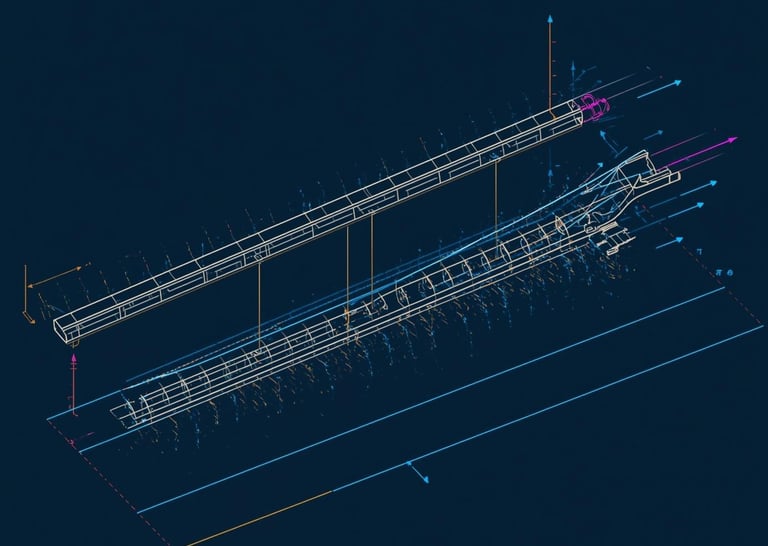
Free beam deflection calculator. Calculate exact sag, bending stress, and minimum beam size for steel I-beams, wood joists, LVL, and aluminum. Check L/360, L/240 code compliance for floors, roofs, and decks. No signup needed.
© 2026 Numovix. All rights reserved.
Calculators Categories
Digital & Tech
Converters Categories